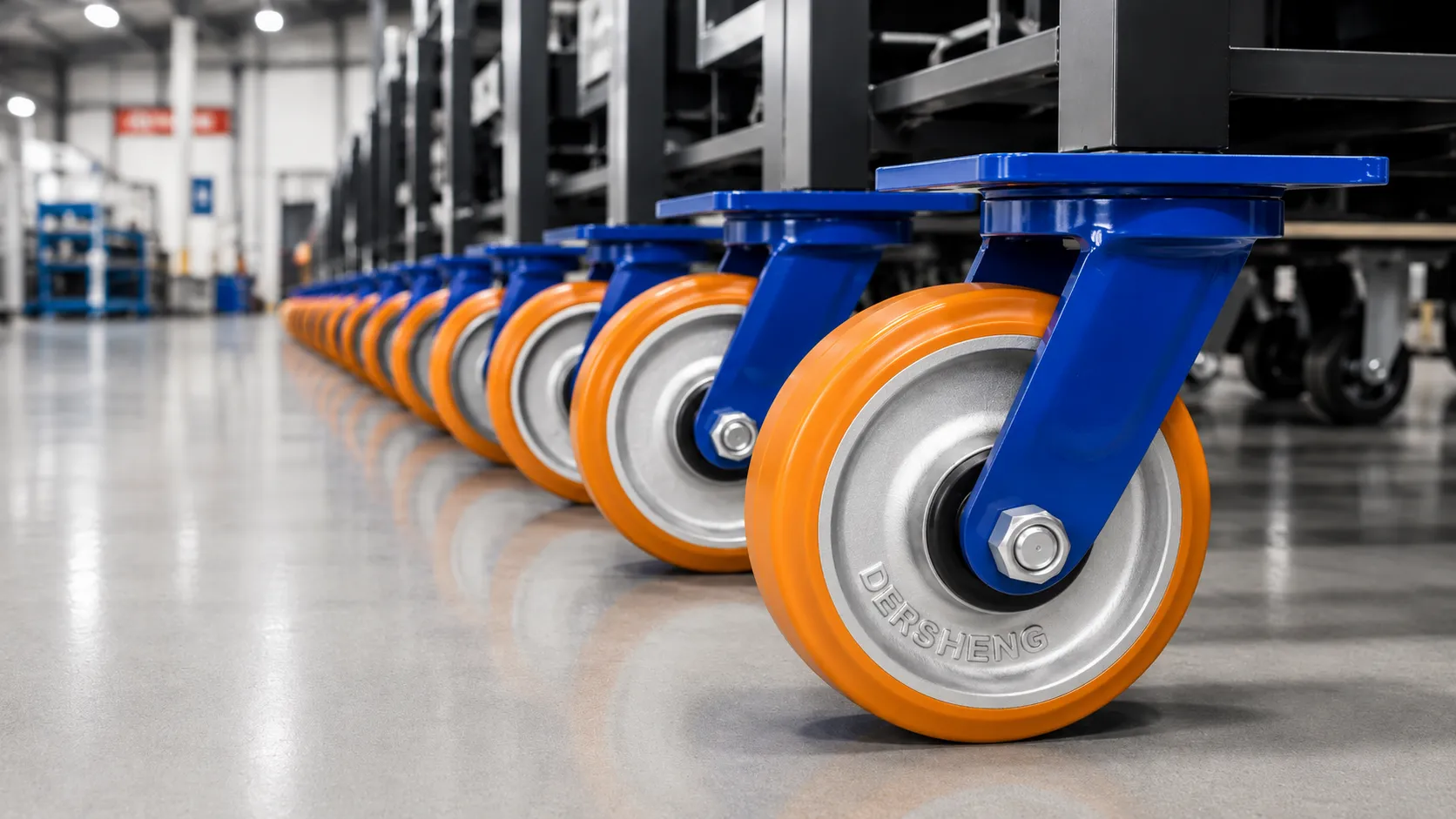
How to choose IndustrialCaster? Quick summary of key selection points
The core of IndustrialCaster selection is not just to look at the load-bearing Specification, but to also evaluate the load, floor, wheel material, wheel diameter, bracket structure and frequency of use. If there are ground joints, thresholds, oil stains, moisture, frequent turns or heavy loads on site, the safety factor should be increased and the grade of the wheel material and bracket should be re-confirmed.
- ● Calculate the weight first: Confirm the weight of the equipment body, the maximum load and the position of the center of gravity, and then estimate the safe load of the wheel.
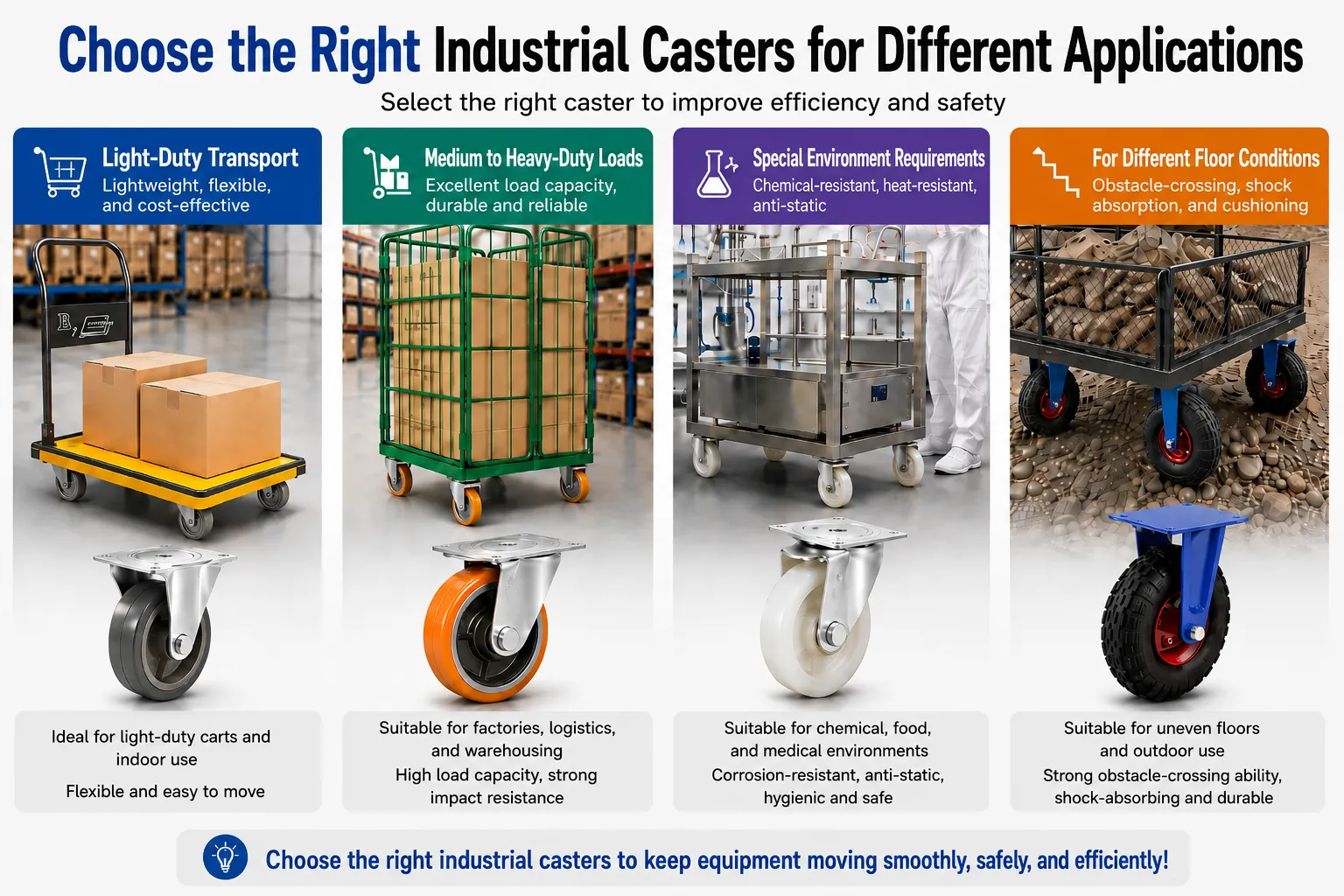
- ● Look at the ground again: If the ground is flat, PU or NylonWheel can be evaluated first; if the ground is uneven, has thresholds or needs to be muted, Rubber Wheel or shock-absorbing Wheel can be evaluated.
- ● Confirm Wheel material: PU Wheel focuses on wear resistance and labor saving, Rubber Wheel focuses on shock absorption and low noise, Nylon and PP wheel suitable for oil resistance, chemical resistance or high load flat ground.
- ● Matching bracket: Move in a straight line, frequently turn, park in a safe and clean environment, choose fixed wheel, movable swivel caster, brake caster or stainless steel bracket.
IndustrialCaster Selection Checklist
| Check items | Information that needs to be confirmed | Impact focus |
|---|---|---|
| Weight and center of gravity | equipment weight, maximum load, center of gravity position, whether it is unbalanced | Wheel safety load, bracket strength and wheel number configuration |
| ground conditions | Epoxy floor, cement floor, steel plate, threshold, expansion joint, ramp | Wheel diameter, wheel material, shock absorber requirements and implementation resistance |
| Frequency of use | Number of moves per day, distance moved, whether the vehicle is parked under heavy load for a long time | Wear resistance, deformation resistance, bearing life and maintenance intervals |
| environmental conditions | Oil, moisture, dust, cleaning agents, food or medical hygiene requirements | Chemical resistant wheel material, stainless steel bracket and bearing seal grade |
| Operation mode | Manual propulsion, mechanical traction, frequent steering, whether braking is required |
This article is compiled by a technical team with experience in IndustrialCaster, Heavy Duty Casters, PU Wheel materials, shock absorber Wheels and customized wheel sets. The content is based on actual Wheel material processing, dynamic load, wear resistance, rolling resistance and on-site selection experience.
What is Industrial Caster? The key to low-effort implementation
IndustrialCaster is widely used in factory Equipment, Logistics carts, warehousing trucks and various types of machinery Equipment. It is an important part to assist in the movement of heavy objects. A good Caster configuration is not only "load-bearing", but also needs to strike a balance between labor-saving implementation, smooth steering, ground protection, wear-resistant life and safe parking.
For enterprises, correct selection can reduce the burden of personnel implementation, reduce the risk of Equipment movement, and avoid premature damage to the wheel surface, bracket or bearing.

The following video describes the differences in the actual application of IndustrialCaster in factories, warehousing and logistics handling situations. It can be observed from the video that the rolling resistance of PU Wheel is significantly lower than that of Rubber Wheel when pushing heavy loads on flat ground, making starting and turning more labor-saving; Rubber Wheel has better shock absorption effect when passing through ground joints or thresholds, and the shaking of goods is smaller. The choice of wheel diameter size and bracket form will also directly affect the pushing feel, equipment height and steering radius. Comprehensive assessment is required based on on-site working conditions.
If the video cannot be played normally, you can Go to YouTube to watch the IndustrialCaster selection video.
Two major factors affecting the labor-saving implementation of the caster
Many people think that the equipment is difficult to push just because the load is too heavy, but in fact, the caster will produce "rotational resistance" when rolling forward, and the swivel caster will also produce "rotational resistance" when it changes direction. The wheel diameter, wheel surface material, bearing structure, bracket rotation performance and ground flatness will all affect the pushing feel.
From the perspective of the concept of rolling resistance, under the same load, a larger wheel diameter usually saves effort and is easier to cross ground joints, thresholds or uneven roads. However, the larger the wheel diameter, the better, because an increase in the wheel diameter will also increase the installation height of the equipment, make the center of gravity higher, and increase the swivel caster rotation radius. If working in a narrow production line aisle or in an elevator, it may cause a turning dead corner.
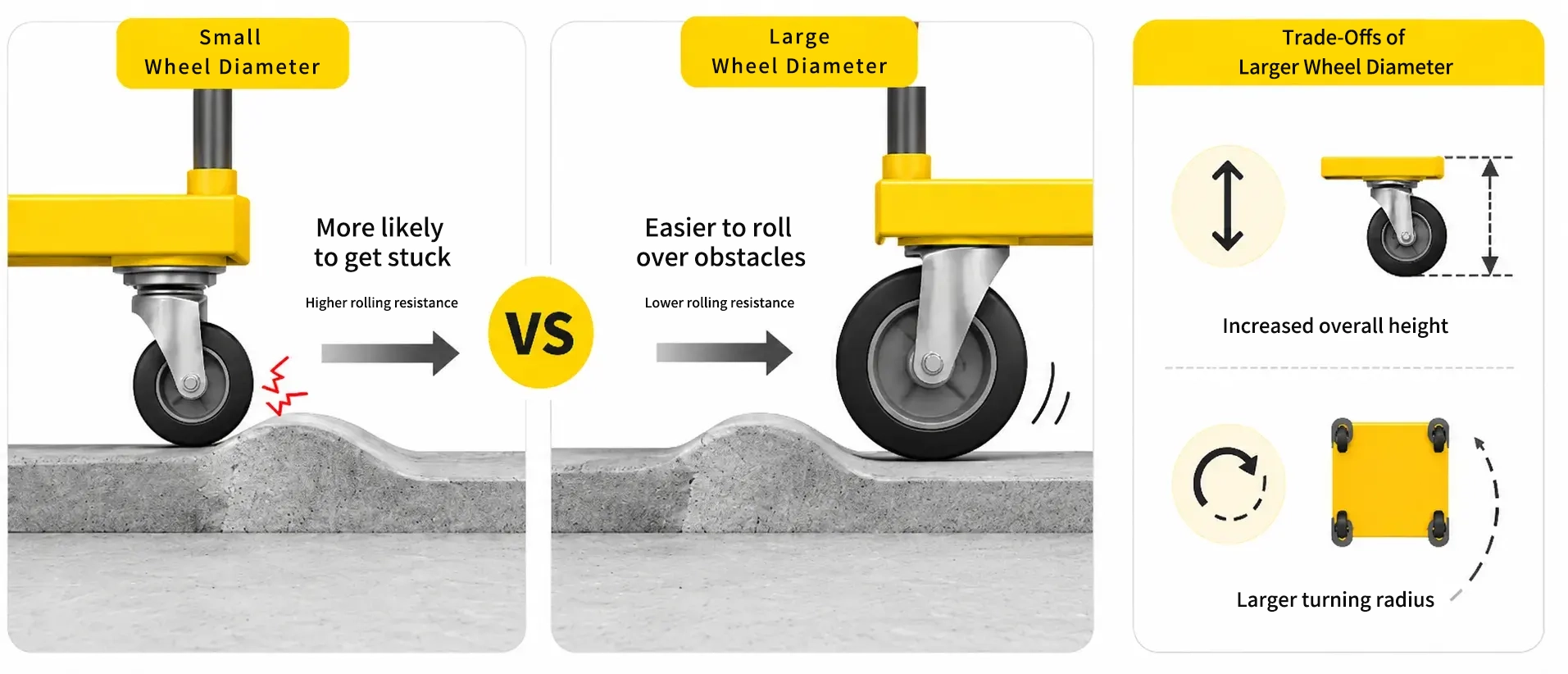
When the wheel diameter is larger, it is usually easier to cross joints, thresholds and uneven roads, and the rolling resistance is also smaller.
However, the increase in wheel diameter will increase the equipment height and rotation radius. When selecting, labor saving, stability and working space must be considered at the same time.
Therefore, when selecting a model, a balance should be struck between "effort-saving implementation", "Equipment height", "turning radius" and "moving stability".
Common Caster functions and installation methods for industrial carts
In order to meet different Equipment and transportation needs, the common functions of IndustrialCaster can be divided into rigid caster, movable Wheel and brake caster. The installation methods include base plate type, screw type (tooth core type) and plug-in rod type. Different structures will affect the load-bearing capacity, installation stability and Suitable Equipment type.
Common Caster Forms
| Caster form | Applicable situations and features |
|---|---|
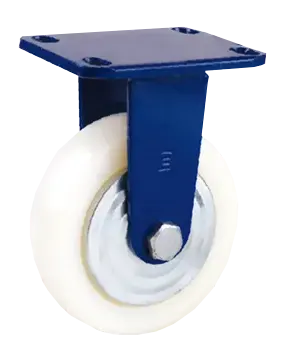 Rigid Caster | Mainly designed with one-way linear movement; suitable for Equipment that requires linear movement, and can provide better travel stability. |
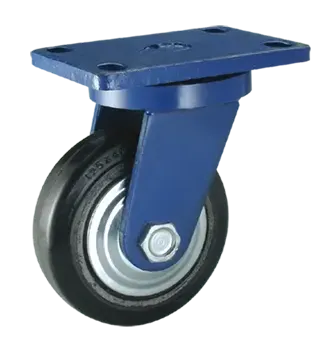 Swivel Wheel/Wanxiang Wheel | It can rotate 360 degrees, making it easier to turn the cart or equipment in narrow spaces. |
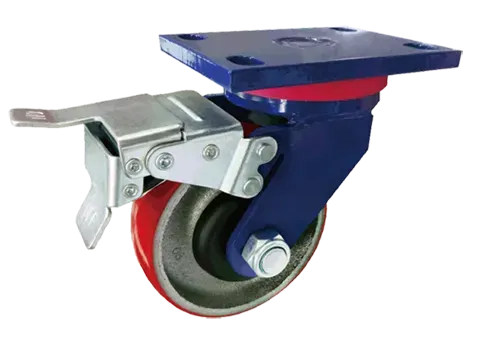 BrakeWheel | It can fix the position when the equipment is parked, reducing the risk of sliding and improving work safety. |
Common installation methods
| Installation method | Applicable situations and features |
|---|---|
| Base plate type | Suitable for Equipment with higher load-carrying requirements or stable locking. |
| Thread type/Tooth core type | Suitable for specific machines, frames or Equipment that requires screw installation. |
| Pole type | Commonly found in light and medium equipment or specific pipe rack structures. |
What are the common heavy-duty wheel materials for industrial use? PU, Rubber, Nylon, PP can be understood at once
The wheel material will determine the feel, wear resistance, shock absorption effect, rolling resistance, chemical resistance and service life. The following is a summary of the differences between PU Wheel, Industrial Grade Rubber Wheel, NylonWheel and PP Wheel.
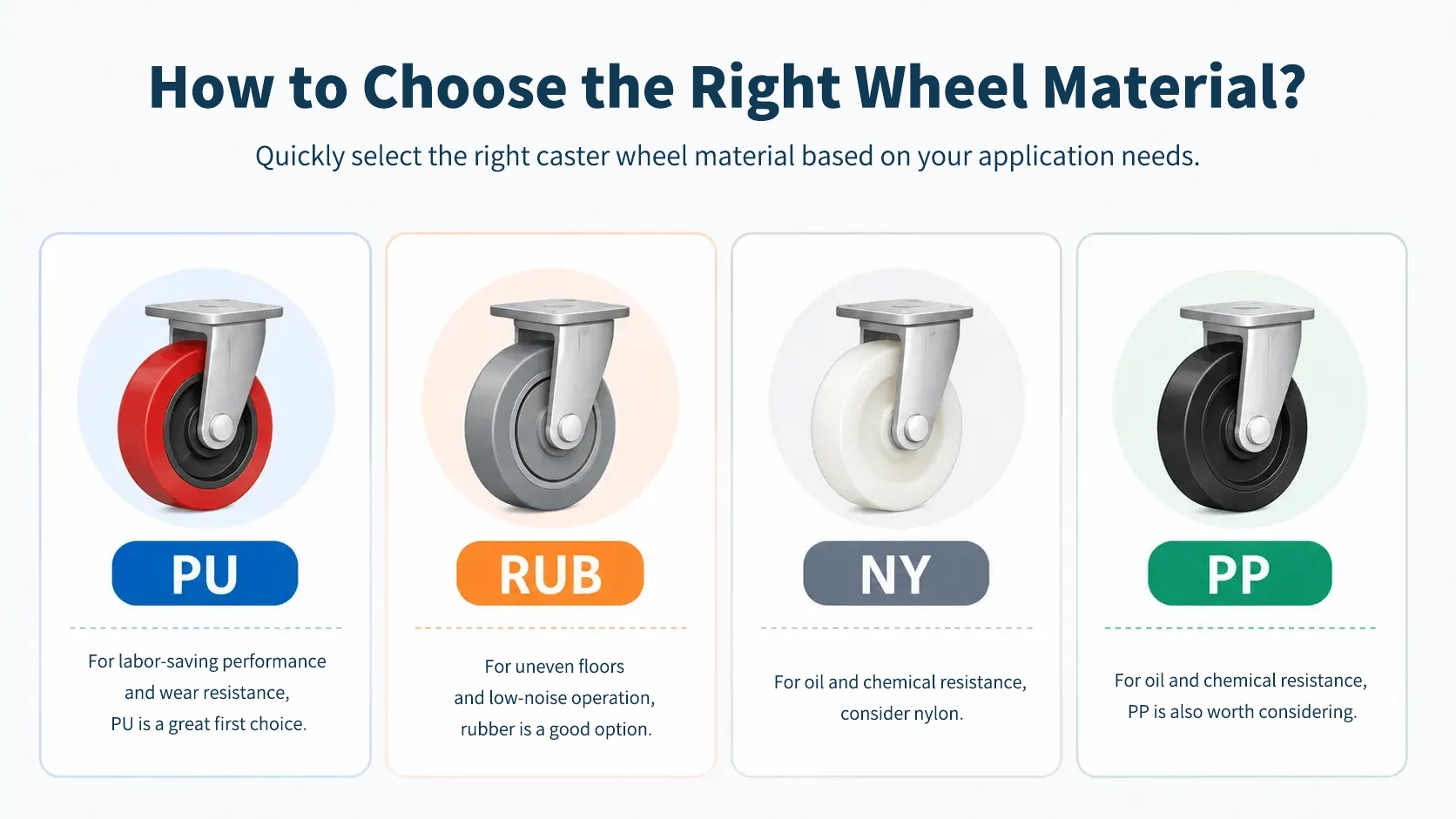
If you pay attention to labor saving and wear resistance, you can look at PU first;
If the ground is uneven and low noise is required, you can give priority to Rubber;
If the environment requires oil and chemical resistance, Nylon or PP can be evaluated.
● PU: Wear-resistant, labor-saving to implement, and also considers ground protection.
● Rubber: shock absorber, low noise, more suitable for uneven ground.
● Nylon/PP: Oil-resistant, chemical-resistant; suitable for specific working conditions.
| Material | Load-bearing capacity (reference) | Main features | Applicable occasions |
|---|---|---|---|
| (PU Wheel) | Approximately 50~2,000 kg | Wear-resistant, impact-resistant, low rolling resistance, less likely to deform under heavy load conditions, less laborious to implement, and has good ground protection effect, not easy to leave scratches or wheel marks. | Factory environment, Logistics handling, Automation handling equipment (AMR/AGV). |
| Industrial Grade Rubber Wheel | About 30~800kg | It has good elasticity and shock-absorbing effect, can absorb vibration and noise during transportation, and has better floor protection. | The ground is uneven and the transport environment requires silence or floor protection. |
| NylonWheel | About 100~3,000 kg | It has high rigidity, good compressive strength, good oil and chemical resistance, stable performance under high temperature environment, and is not easy to deform under heavy load for a long time. | Industrial environment with heavy equipment, high load and flat ground. |
| PP Wheel | About 50~600kg | Lightweight, resistant to chemical corrosion, and cost-effective, it is suitable for transportation situations that do not require high shock absorption. | Light and medium-sized Material Handling Equipment, turnover vehicles, chemical environment auxiliary carts. |
*The above load-bearing range is a general reference value. The actual specifications varies depending on the product model, wheel diameter and usage conditions. It is recommended to confirm with actual working conditions before selection.
How to Choose a Heavy-Duty Industrial Caster? Key Industrial Caster Selection Tips
When choosing a heavy-duty wheel for industrial use, the load-bearing capacity is important, but if you only look at the load data in the catalog, it often cannot reflect the actual usage conditions. Equipment may produce additional impact forces when moving, turning, starting or passing through ground joints. Therefore, in addition to confirming the total weight of the equipment, it is also necessary to include the use environment, transportation method and safety factor into the assessment.
It is not recommended to calculate the safe load of IndustrialCaster by just "dividing the total weight by 4". In actual use, ground height differences, steering movements or shifts in the center of gravity of the load may cause some Casters to bear greater pressure. In practice, the more conservative load-bearing method of 3 Casters can be used to estimate:
Generally, for a four-wheel stroller, when the ground is uneven, steering or the center of gravity shifts, only 3 wheels may bear the main load, so "total weight ÷ 3" is often used as a conservative estimate. If there are ramps, thresholds, mechanical traction, long-term heavy loads or high-frequency use, it is recommended to increase the safety factor.
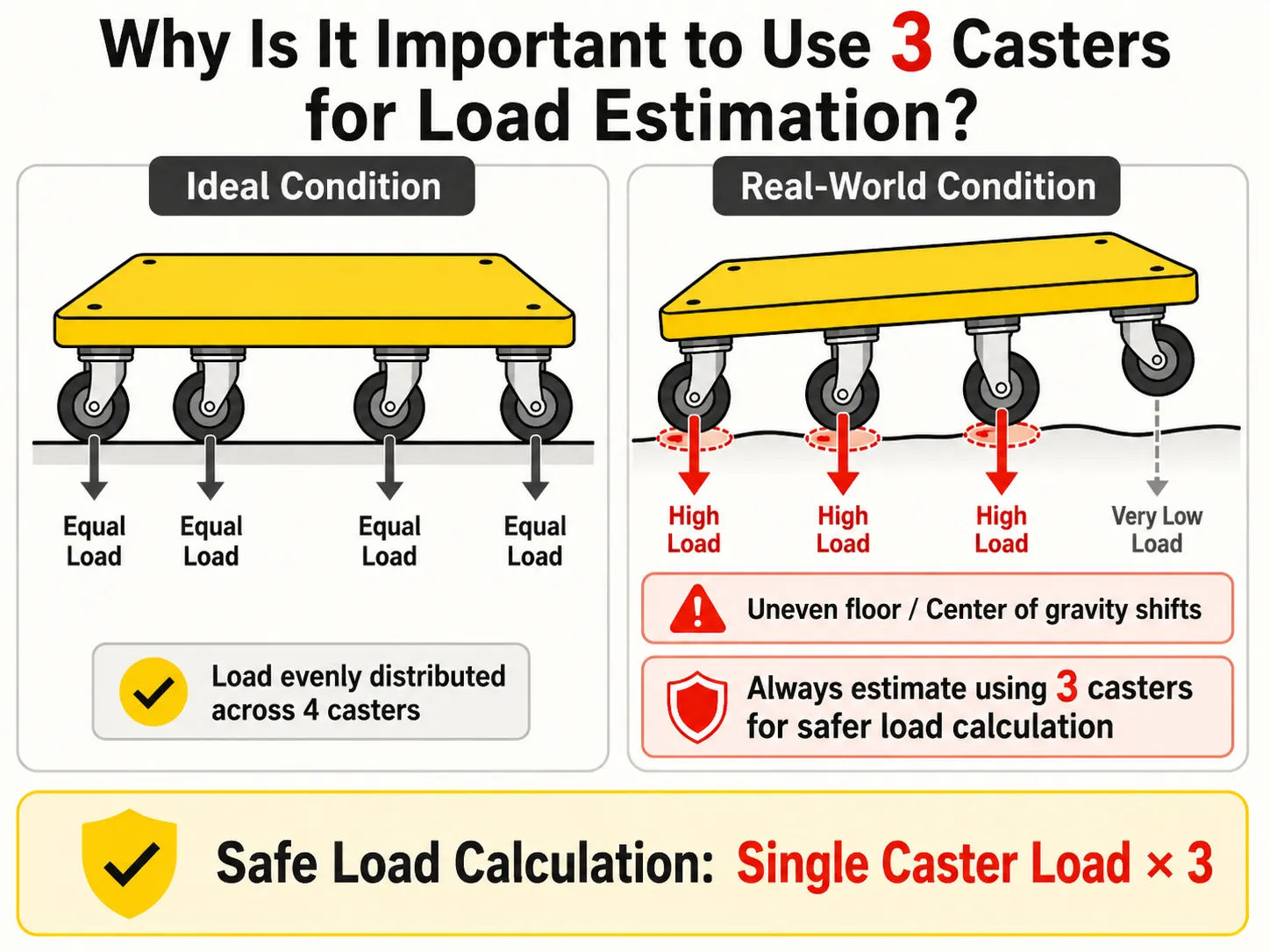
In practice, even if four Casters are installed, some Casters may bear a larger load due to uneven ground, shifting center of gravity, steering or impact.
Therefore, Industrial Applications often use the load-bearing capacity of 3 Casters as a more conservative safety estimate.
For example: If the load of a single Caster is 100 kg, and when four Casters are installed, it is recommended that the total weight of the overall equipment and load should be within 300 kg as a safer estimate. If the use environment includes uneven ground, frequent turns, drop impacts, long-term heavy loads or high-speed movement, it is recommended to increase the safety factor.
De-identified working conditions case: 900 kg heavy-duty machine moved on jointed ground
Working conditions: The indoor cement floor of the metal processing plant. The total weight of the equipment body and the load is about 900 kg. It adopts a 4-wheel configuration. The transportation route includes ground joints and small drops, and needs to be pushed by personnel at low speed and occasionally turned for positioning.
On-site phenomena: The original configuration was only estimated based on the average load-bearing capacity of 4 wheels. During actual implementation, due to the ground drop and center of gravity shift, some wheel groups were subjected to higher instantaneous loads, causing difficulty in starting, heavy steering, and local wear on the wheel surface.
Selection adjustment: Re-estimate the load-bearing capacity of 3 Wheels, 900 ÷ 3 = 300 kg. It is recommended that the wheel load be at least 300 kg. If frequent joints need to be crossed, further evaluate the larger Wheel diameter, PU Wheel or shock-absorbing Wheel configuration, and confirm the impact resistance of the bracket and bearings.
Selection reminder for special working conditions
| Working conditions | Possible risks | Selection reminder |
|---|---|---|
| The ground is uneven, with many thresholds or gaps | The pushing resistance increases, the goods vibrate, and the impact on the wheel surface intensifies. | Evaluate the larger wheel diameter, Rubber Wheel or shock absorber wheel configuration, and confirm the impact resistance of the bracket and bearing. |
| Long-term heavy loading or fixed parking | The wheel is overloaded, the rubber is compressed and deformed, and wheel marks remain. | The three-wheel load-bearing estimation method is adopted, and the safety factor is increased according to the load frequency. |
| Oil pollution, chemicals or high humidity cleaning environment | The wheel material swells, corrodes, and the bearing life is reduced. | Confirm that the wheel material is oil-resistant and chemical-resistant, and match the corresponding bracket surface treatment and bearing structure. |
| Mechanical traction, frequent turns or high lateral impact | The bracket is deformed, the bearing is damaged, and the wheel surface is abnormally worn. | Evaluate reinforced brackets, anti-side thrust design, double wheel structure or higher level bearing configuration. |
Quickly compare and select models based on site conditions
The recommended configurations corresponding to five common working conditions are summarized below. You can directly compare according to your own on-site situation. If multiple conditions are met at the same time, it is recommended to first confirm the load-bearing safety, then select the wheel material according to the ground, and finally select the surface treatment of the bracket.
| Site conditions | Priority recommended configuration | Reasons for selection |
|---|---|---|
| The ground is flat and heavy loads are moved frequently. | PU Wheel + base plate bracket | Low rolling resistance, wear-resistant, leaving no wheel marks, and the labor-saving effect is obvious after long-term operation. |
| The floor is uneven, with seams or thresholds | Larger wheel diameter Rubber Wheel or shock absorber Wheel | It has good shock-absorbing and buffering effects, making it easier to cross obstacles and reduce cargo shaking and wheel surface impact. |
| Oil pollution, chemicals or cleaning environment | NylonWheel or PP Wheel + stainless steel bracket | It is resistant to chemical corrosion and not easy to swell. It can be used with a stainless steel bracket to extend the overall service life. |
| Need to be silent (Medical / food factory) | Rubber Wheel or PU Wheel + Precision Bearing | It has low noise, small vibration, and smooth operation. It is suitable for situations where quietness of the working environment is required. |
| Occasionally shifting after being parked at a fixed location for a long time | To improve safety, choose PU Wheel or heavy-duty NylonWheel | After being pressed hard for a long time, the wheel material with insufficient resilience is prone to flat spots, resulting in uneven running or residual wheel marks. |
1. Confirm the total weight: equipment weight + maximum load
2. Calculate the wheel safety load: total weight ÷ 3
3. Confirm the ground conditions: flat, rough, threshold, oily, damp
4. Choose wheel material: PU, Rubber, Nylon, PP
5. Select the bracket and function: fixed, movable, braking, shock absorber, heavy-duty bracket
Wheel recommended for industrial use|Dershenganghao Wheel provides multiple load handling solutions
The choice of Wheel for industrial use will directly affect the load-bearing stability of Equipment when moving, implementation efficiency and subsequent maintenance costs. If the use environment involves heavy-load handling, long-term movement, frequent turns or special ground conditions, in addition to confirming the wheel load, it is also necessary to simultaneously evaluate the wheel material, Wheel diameter, bracket structure, bearing form and brake configuration.
As a professional Caster manufacturer, Get a good WheelWe have long been involved in the R&D and manufacturing of Industrial Casters, Heavy Duty Casters and Extra Heavy Duty Casters. We provide multiple Specification and customized configuration services to help companies select more suitable Industrial Wheel and wheel set solutions based on equipment weight, handling methods and usage environment.
IndustrialCaster recommends: Choose the appropriate Series according to the handling situation
If you have confirmed the equipment weight, ground conditions and usage environment, you can quickly correspond to the common Series of Wheels according to the table below, and then further confirm the wheel diameter, Wheel material, bracket and brake configuration.
| handling situation | Recommended Series | Suitable for reasons |
|---|---|---|
| General heavy load handling | Super Heavy Duty IndustrialCaster Series Heavy IndustrialCaster Series | Suitable for factories, warehousing and general equipment movement, taking into account load-bearing, wear-resistant and daily handling requirements. |
| Overload Equipment | 1102 Series Super Heavy Duty Type B Caster Series 1162 Series Elephant Foot Super Heavy Duty Caster Series | Suitable for high load, low-speed transportation and large Equipment support, focusing on load-bearing stability and bracket strength. |
| The ground is uneven or shock absorbers are needed | 1115 Series load capacityspring shock absorberWheel Series | It can reduce vibration and impact during transportation. Suitable for ground joints, thresholds or areas where equipment needs to be protected. |
| Frequent turns or side impacts | 1113 Series Slanted Bead Type Heavy Duty Caster Series 1142 Series Long Bead Impact Resistant Caster Series | Suitable for heavy-duty steering, mechanical traction or applications with high lateral force, it can improve rotation stability and impact resistance. |
| Medical, silent or clean needs | 1129 Series Medical Series | Suitable for equipment and sites that have requirements for noise, smooth implementation and environmental cleanliness. |
| US standard Equipment or special tripod requirements | 1130 Series 30 Series American Standard Tripod Series 1109 Series American Wheel Series | Suitable for applications that require specific US-standard structures, tripod dimensions or replacement of existing Equipment. |
Need help evaluating the IndustrialCasterSpecification?
Please provide "equipment weight, load, ground conditions, usage environment, installation method", and Dersheng can assist in evaluating the appropriate wheel diameter, wheel material and bracket configuration.
Contact us at WheelFrequently Asked Questions
How does IndustrialCaster calculate safe load? Why is it commonly used to estimate the load-bearing capacity of 3 wheels?
It is recommended that IndustrialCaster's safe load be estimated by adding the equipment weight plus the maximum load, and using the load-bearing capacity of 3 Wheels as a more conservative benchmark.
Generally speaking, although 4 Casters are the most common, the ground is uneven, the center of gravity is shifted, and when turning or crossing a threshold, the 4 Wheels do not necessarily bear equal force. Therefore, Industrial Applications often estimate the load-bearing capacity of 3 Wheels. The simplified formula is: The recommended load of a single Caster is ≥ (Equipment body weight + maximum load) ÷ 3. If the site has ramps, mechanical traction, long-term heavy loads or frequent impacts, It is recommended to increase the safety factor.
How to choose between heavy-duty Wheel, PU Wheel, Rubber Wheel, NylonWheel and PP Wheel?
PU Wheel focuses on wear resistance and labor saving, Rubber Wheel focuses on shock absorption and low noise, Nylonwheel suitable for high load flat ground, PP wheel suitable for light and medium duty and chemical resistant environment.
When choosing a wheel material, you should not only look at the load-bearing capacity, but also evaluate the floor material, noise, resistance to movement, abrasion resistance, oil resistance and contact with detergents or chemicals. If the floor is flat and the material is frequently transported, PU Wheel is usually a more balanced choice; if the floor is uneven or the goods are shaken, you can evaluate Rubber Wheel or shock-absorbing Wheel.
Is the larger the wheel diameter necessarily better for pushing? Will it affect the equipment's height or center of gravity stability?
The larger the wheel diameter, the easier it is to overcome obstacles, but it will also increase the equipment height, center of gravity and swivel caster rotation radius.
If the equipment needs to pass through thresholds, joints or rough ground, a larger Wheel diameter can usually reduce rolling resistance. However, if the equipment has a high center of gravity, a narrow passage or requires frequent steering, an excessively large Wheel diameter may cause steering dead corners or stability problems, so a comprehensive judgment still needs to be made based on the load, Equipment height, center of gravity and moving lines.
When the ground is uneven and there are thresholds or expansion joints, how should I choose IndustrialCaster?
When the ground is uneven, priority should be given to evaluating the larger wheel diameter, Rubber Wheel, PU Wheel or shock absorber wheel, and confirming the impact resistance of the bracket and bearing.
If the transportation route contains thresholds, expansion joints, ditch covers or small drops, the wheel assembly will bear additional impact, which may easily cause increased pushing resistance, damage to the wheel surface and vibration of the cargo. At this time, a larger Wheel diameter, a wheel material with better elasticity, or a load spring shock absorber Wheel configuration can be considered.
Heavy Equipment is difficult to push after being parked at a fixed location for a long time. Is it because the caster was chosen incorrectly?
It may be caused by pressure deformation of the wheel material, insufficient Wheel load or insufficient safety factor.
Heavy pressure at a fixed point for a long time will cause flat spots or compression deformation in part of the wheel material, resulting in increased starting resistance, uneven running, or wheel marks on the ground. If the equipment is often parked with heavy loads and then moved, it is recommended to choose a PU Wheel or heavy-duty Nylon Wheel with better resistance to deformation, and increase the wheel load specification.
How often does Caster need maintenance or replacement? What are the signs that the wheel needs to be replaced?
It is generally recommended to inspect every 3 to 6 months, and for high-frequency heavy-load use, it is recommended to inspect every 1 to 2 months.
The key points to check include whether the bearings are smooth, whether there are cracks, flat spots, nicks or abnormal wear on the wheel surface, whether the bracket is deformed, and whether the brake can be firmly fixed. If there is abnormal noise when pushing, the steering is obviously heavier or the wheel surface is damaged, it is not recommended to continue using it with a load.
What is the difference between stainless steel brackets and ordinary steel brackets? When should you choose stainless steel?
Stainless steel brackets are mainly suitable for moisture, cleaning, salt spray, food, medical and pharmaceutical fields that require corrosion resistance or hygiene levels.
Generally, electroplated or painted steel brackets are suitable for dry indoor environments and have lower costs; stainless steel brackets are suitable for environments with long-term exposure to moisture, detergents or high-pressure water washing. When selecting, you should also confirm the chemical resistance of the wheel material and the bearing sealing grade.
How to match the rigid caster and the movable swivel caster?
For linear movement, 2 rigid casters + 2 swivel casters are available; for frequent steering in narrow spaces, 4 fully swivel casters are available.
2 fixed wheels + 2 swivel casters can improve the stability of straight line travel and reduce deviation; 4 fully swivel casters provide flexible steering and are suitable for narrow passages or equipment that requires lateral adjustment. For super heavy equipment or occasions that require precise orientation, it is recommended to evaluate the fixed wheel, swivel caster, braking wheel and guide structure according to the moving line.