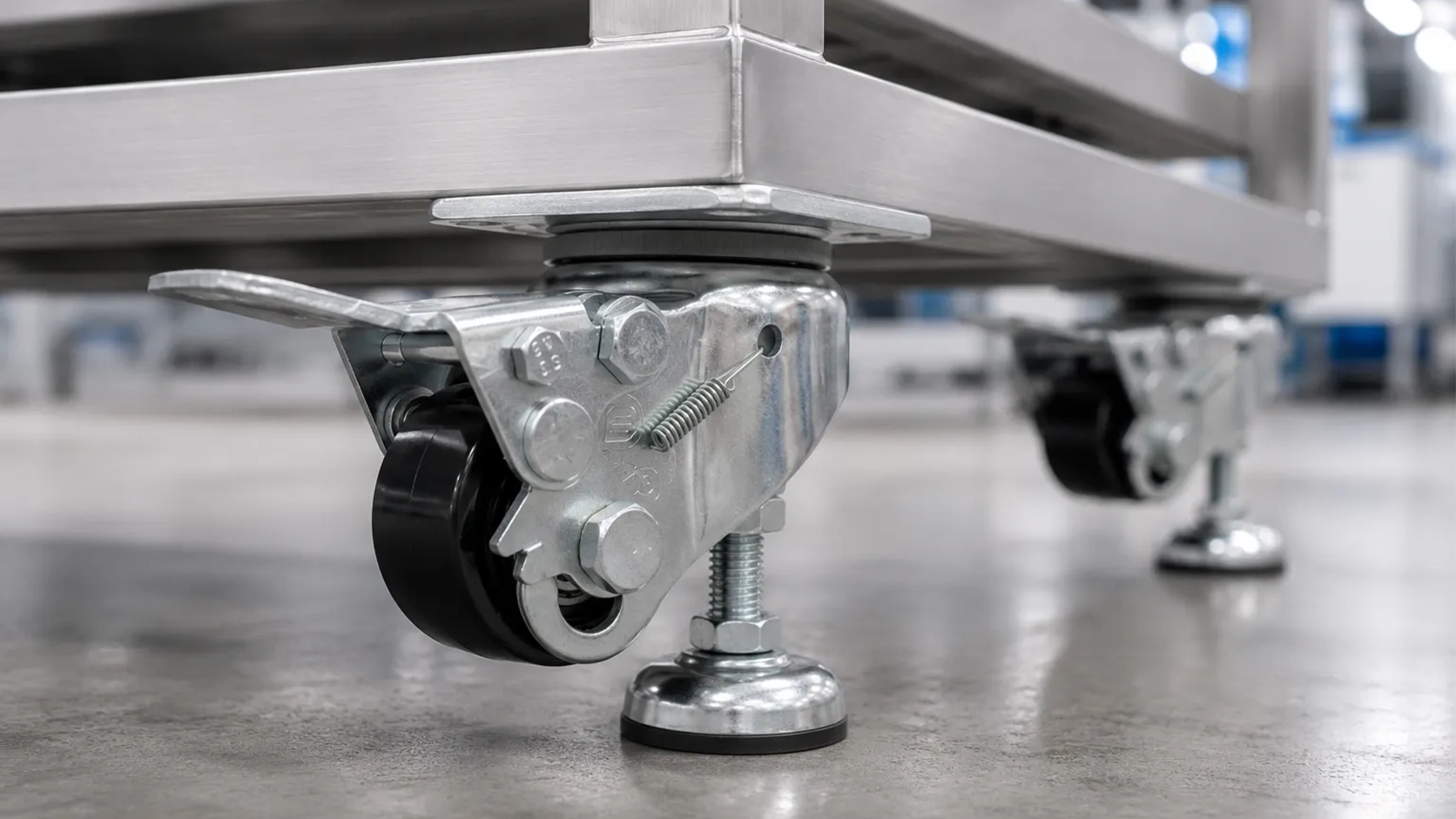
30-Second Quick Summary: Leveling Caster Selection Essentials
- Function first: A leveling caster combines a swivel caster's mobility with a leveling foot's fixed support — once positioned, it switches to a stable, load-bearing state.
- Then load: While moving, estimate dynamic load using the "3-wheel load" method; once fixed, separately confirm the support base's static load.
- Confirm operation: Manual adjustment suits light, rarely-moved equipment; linkage-handle suits heavy machines; foot-lever suits production equipment that switches frequently between mobile and fixed states.
- Match mounting: Plate-mount (multi-bolt) suits heavy precision equipment; threaded-stem screws directly into an existing threaded hole for simpler installation.
What Is a Leveling Caster? Understanding Fixed Support and Height Adjustment
Before installing leveling casters on a production line, precision machine, or automation peripheral equipment, the first step is to understand how leveling casters differ from standard industrial casters. This helps determine whether they meet the equipment's needs for mobility, positioning support, and leveling — ensuring stability and safety during operation.
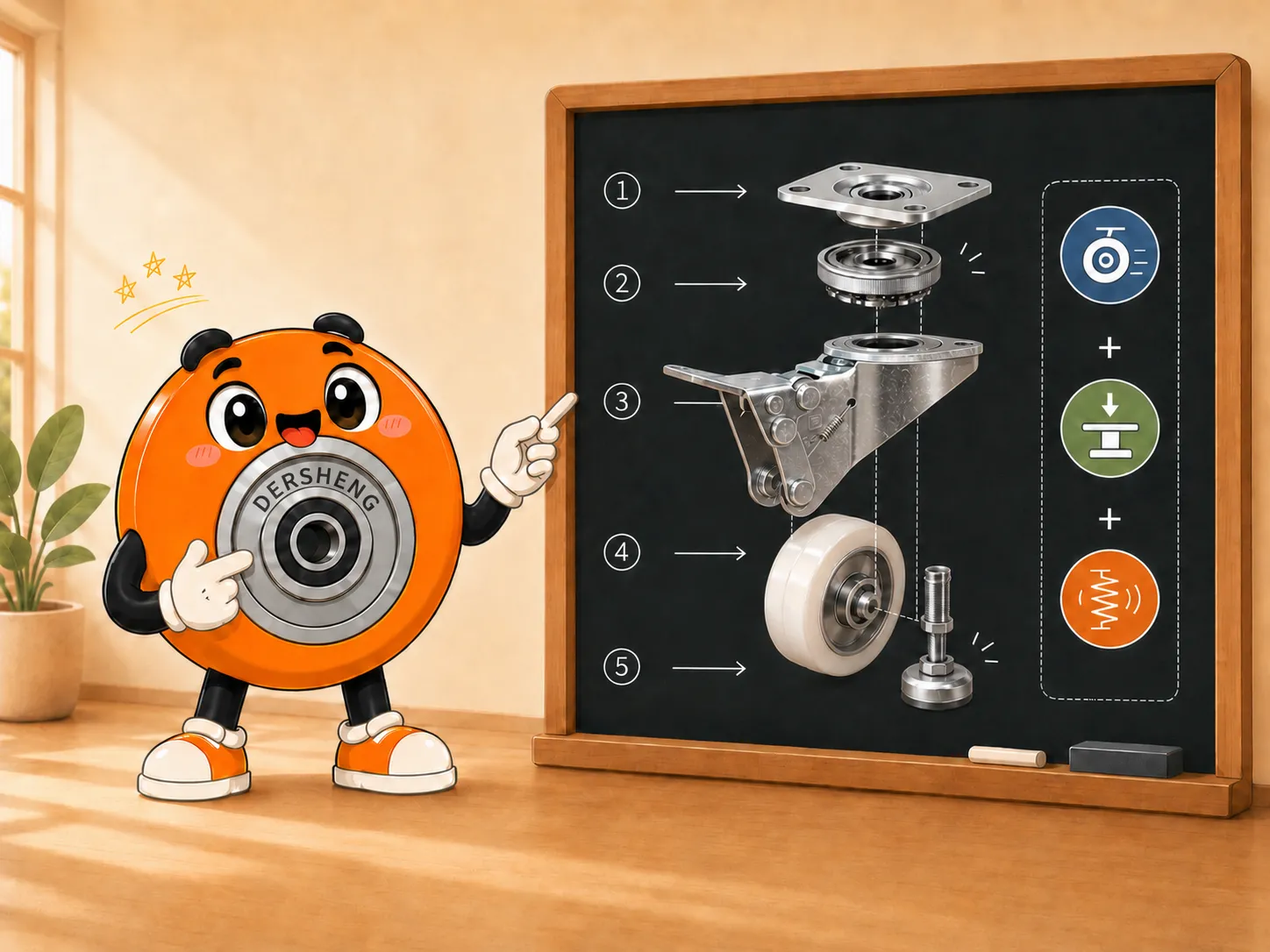
Leveling Caster Structure: A Composite Caster Combining Mobility, Support, and Shock Absorption
A leveling caster — also called an adjustable caster or leveling wheel — is a special functional caster that integrates the "mobility" of a swivel caster with the "support stability" of an adjustable foot into a single structure.
It typically includes a slip-resistant, wear-resistant rubber support base. Once the equipment is moved to the desired position, the operator can use a mechanical adjustment mechanism to lower the internal support base into contact with the floor, lifting the equipment and switching it from a "mobile state" to a "fixed support state."
In addition to compensating for floor height differences and helping machines achieve precise leveling, the support base also absorbs some of the minor vibrations generated during equipment operation, significantly improving positioning stability for precision equipment.
Types of Leveling Casters: Classified by Operating Method and Mounting Style
By operating method, leveling casters can be classified as manual-adjustment, linkage-handle, or foot-lever types. By mounting method, the two most common designs are plate-mount and threaded-stem.
- ● Manual adjustment: Suited for lightweight equipment; the support base is raised or lowered by hand-turning an adjustment dial.
- ● Linkage handle: Suited for heavy equipment; a linkage handle or ratchet mechanism raises and lowers the support base, offering faster, more effortless operation.
- ● Foot lever: Suited for equipment that is frequently reconfigured, repositioned, or moved short distances; the operator switches states with a foot pedal, making it the fastest of the three methods.
- ● Plate-mount: Usually secured with 4 bolts, suited for heavy loads or precision equipment requiring extremely high stability.
- ● Threaded-stem: Screws directly into the equipment's existing threaded hole for simple installation, suited for machines with a compatible existing foot structure.
How to Evaluate Leveling Caster load: Assess Dynamic Load and Static Support Separately
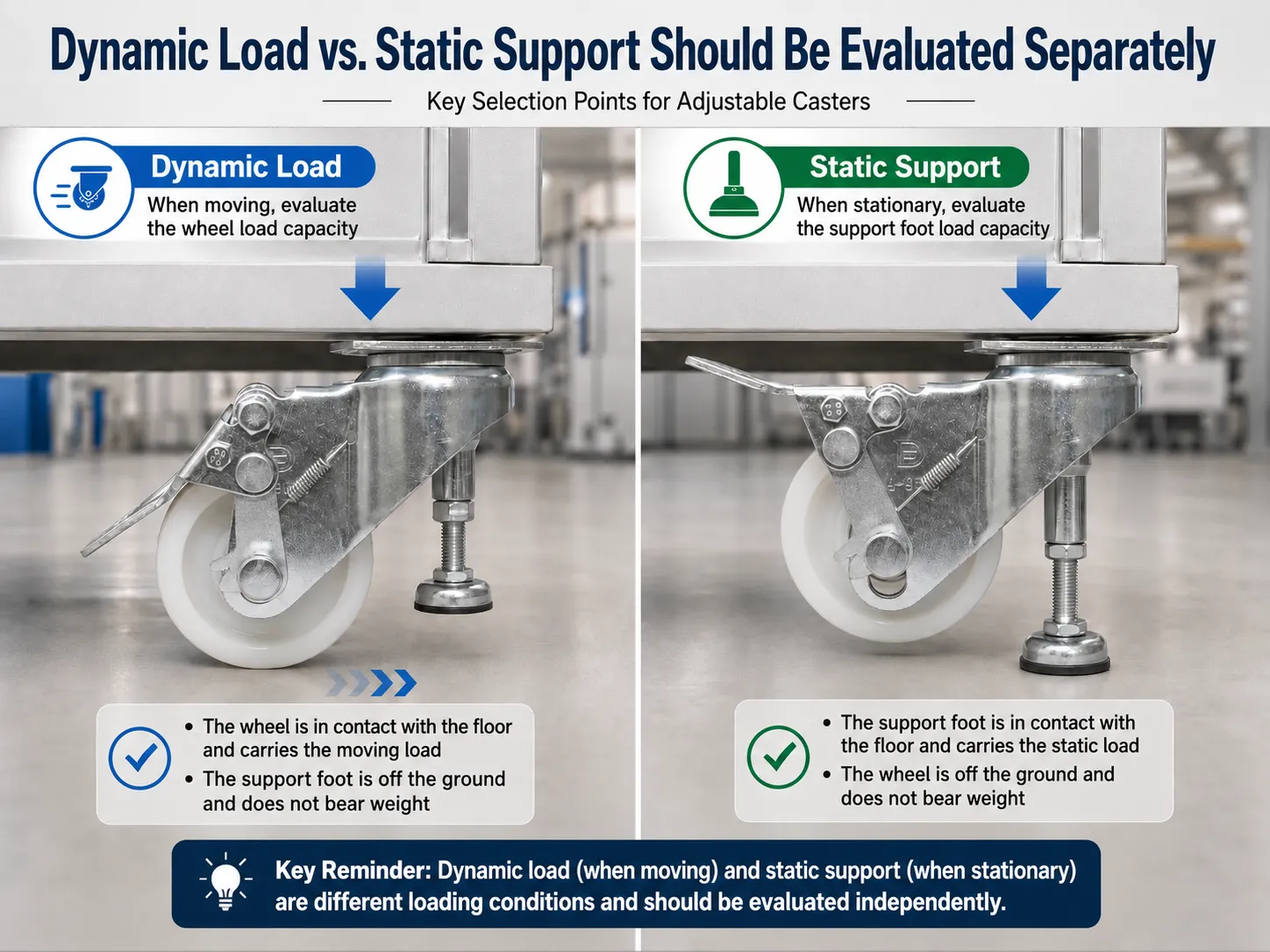
Most buyers select leveling casters by simply dividing the equipment's total weight evenly across each caster. However, the forces on the equipment differ across moving, turning, positioning, and fixed states.
The correct approach is to evaluate "dynamic load" and "static support" independently, ensuring the casters perform optimally in every state.
1. While Moving: Evaluate Dynamic Load and Safety Factor
As equipment is pushed across industrial floors, uneven forces can arise from floor height differences, expansion joints, ramps, turning, or push impacts. As a result, the 4 casters do not necessarily bear an equal load; in practice, a "3-wheel load" basis is commonly used for a conservative safety estimate.
For a flat, indoor floor, the safety factor can be set based on actual operating conditions. If the floor has joints, height differences, ramps, towing impacts, or the equipment is moved frequently, the safety factor should be increased to reduce the risk of momentary overload on the wheel body, bracket, and bearings.
2. While Fixed: Confirm the Static load of the Support Base
The key difference between leveling casters and standard industrial casters is that, once the equipment is fixed in place, the "support base" — not the wheel — bears the equipment's weight over time.
Once the equipment is positioned and the support foot pad touches the floor, the leveling caster enters a "static support" state. At this point, selection should focus not just on wheel load but on the support base's static load, the strength of the adjustment screw, the base's contact area, anti-slip performance, and overall stability.
What Operating Methods Do Leveling Casters Offer? Linkage-Handle vs. Foot-Lever Lift
To accommodate different equipment's load balance, movement frequency, and fixation needs, leveling casters offer a range of operating mechanisms. The right adjustment method should be selected based on equipment weight, operating frequency, adjustment precision, and available workspace.
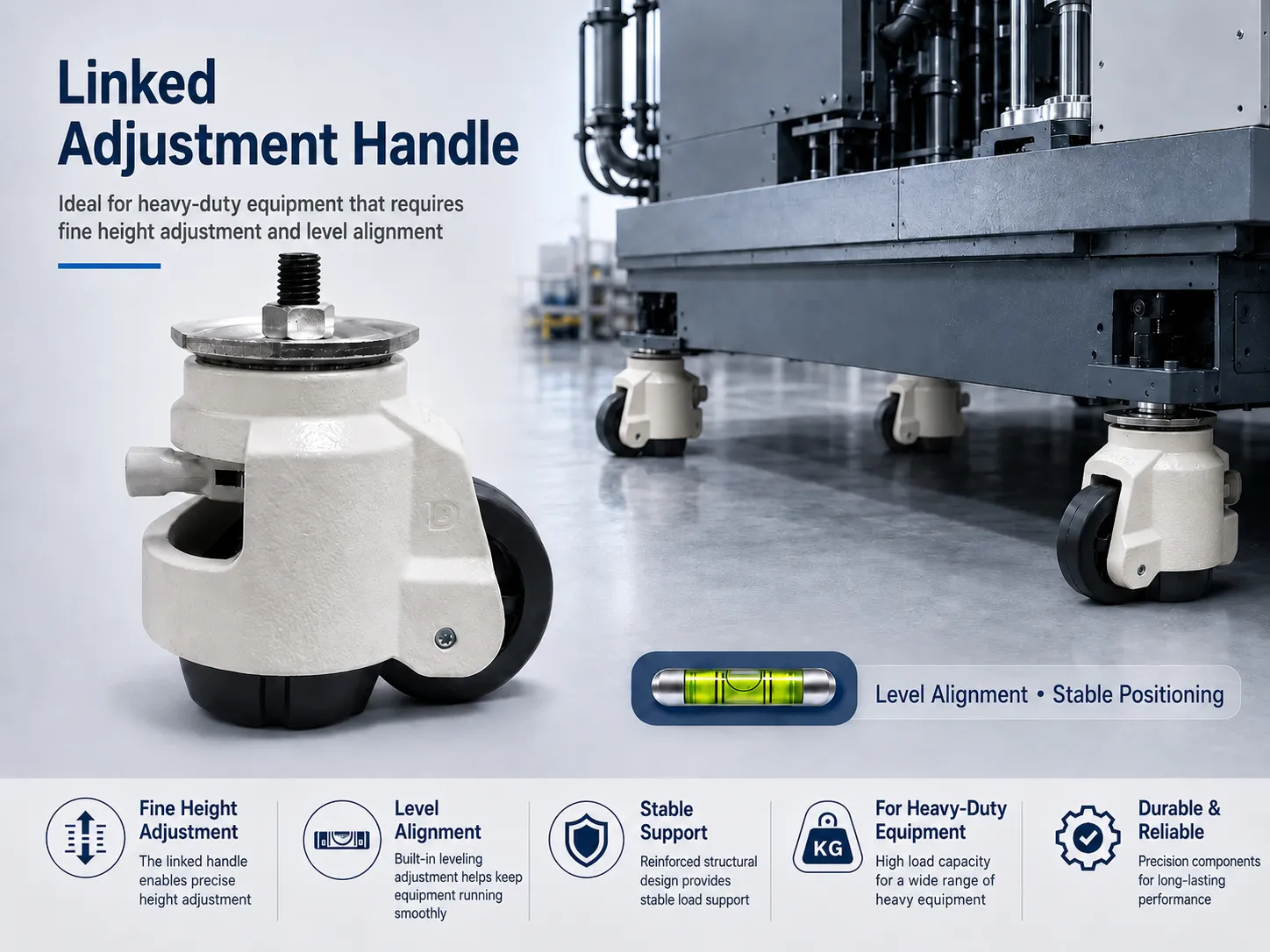
Linkage Handle: For Heavy Machines Needing Fine Height Adjustment and Leveling
Traditional hand-wheel adjustment casters can be difficult and strenuous to operate on large or heavy machines due to high loads and friction. Heavy precision equipment therefore typically uses a "linkage-handle" adjustment mechanism, letting operators complete fine height adjustment or leveling with far less effort.
These leveling casters are also typically paired with high-strength wheel materials, such as fiber-reinforced PA, to increase load, structural rigidity, and movement stability — making them well-suited to industrial equipment that needs heavy-load movement, positioning, and leveling.
Take DERSHENG's 1169-1 Series Linkage-Handle Leveling Casters as an example: its linkage-handle design lets operators adjust caster height more easily to bring equipment to a level state. This series suits electrical automation equipment, semiconductor equipment, precision cabinets, and large control equipment weighing up to 3 tons.
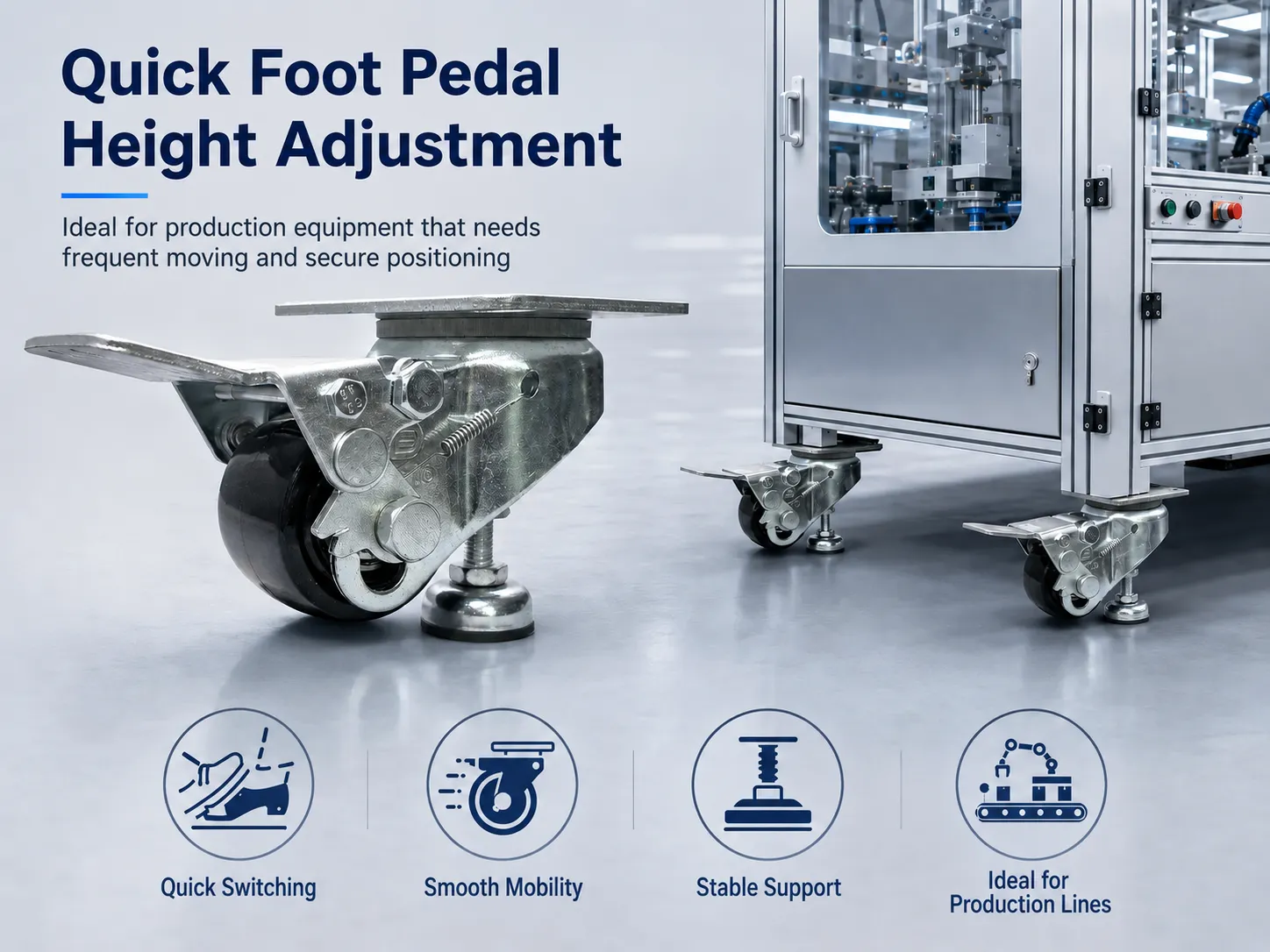
Foot-Lever Quick-Lift Adjustment: For Production Equipment Needing Frequent Mobile/Fixed Switching
For production equipment that is frequently reconfigured, changed over, or moved short distances, a foot-lever lift mechanism is recommended. Operators can quickly switch equipment between "mobile" and "fixed" states with just a foot pedal.
- ● To fix the equipment: Press the pedal to retract the caster wheel and lower the support cup to the floor, providing very high static support.
- ● To move the equipment: Press the pedal to lower the caster wheel and lift the support cup off the floor, restoring the equipment's mobility.
Take DERSHENG's 1168 Series Foot-Lever Lift Casters as an example: depending on the application, they can be paired flexibly with nylon wheels, special hardened-alloy wheels, or high-flexibility dual-row wheels, and the base can be fitted with an anti-static conductive rubber pad — suited for electronics plants, semiconductor plants, precision production lines, and production environments with ESD control requirements.
This footage shows the real-world foot-lever operation of DERSHENG's 1168 Series lift caster, demonstrating how equipment quickly switches between "mobile" and "fixed" states — ideal for production equipment, workstations, and jig platforms that require frequent repositioning.
If the video cannot be played on this page, watch the 1168 Series operation demo on YouTube.
| Operating Method | In Plain Terms | Advantages | Best Suited For |
|---|---|---|---|
| Manual adjustment | Turn by hand to raise or lower the support base | Fine adjustment, intuitive structure | Machines, workbenches, rarely-moved equipment |
| Linkage handle | One handle motion raises/lowers the support base | Faster, less effort | Production equipment, jig tables, workstations |
| Foot lever | Press a foot pedal to switch between mobile and fixed | Fastest operation, less bending | Frequently moved carts, work platforms, production equipment |
Choose DERSHENG Casters for a Leveling Caster Solution Tailored to You!
Leveling casters do more than help equipment move — they are a critical component affecting positioning, leveling, load safety, and operating stability. When selecting one, be sure to consider equipment weight, movement frequency, floor conditions, and fixation needs, and pair them with the right adjustment mechanism and wheel material to ensure equipment use that is efficient, effortless, stable, and safe.
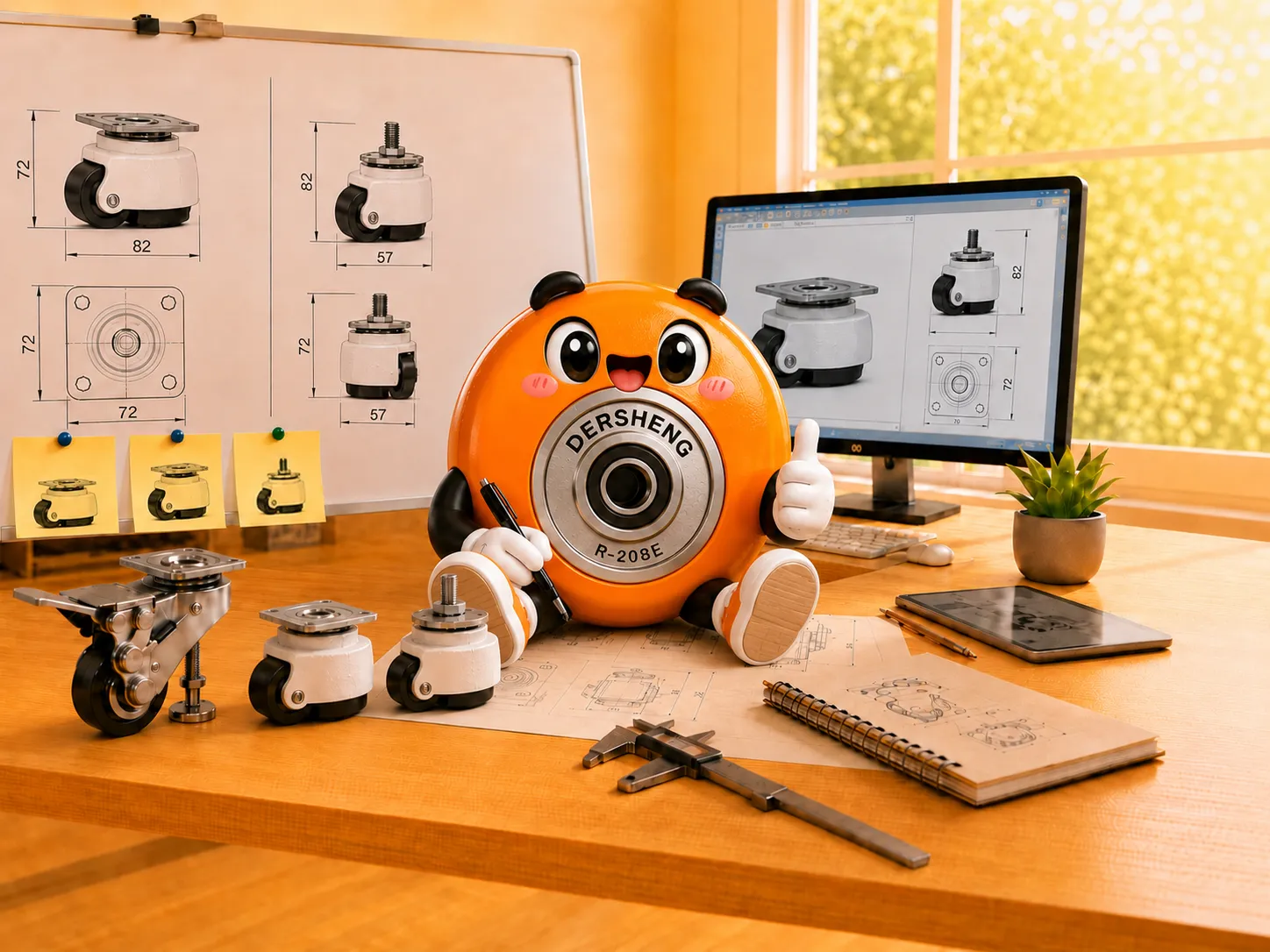
DERSHENG Casters has long specialized in the R&D and manufacturing of industrial casters, special-function wheels, and heavy-duty equipment wheel assemblies, with extensive experience across industrial, medical, warehousing, and commercial equipment sectors. We tailor leveling casters and height-adjustment solutions to the needs of different production lines, machines, and environments.
1169-1 Leveling Casters
Best for: Fine height adjustment on heavy machines.
Operating advantage: The linkage-handle design allows effortless fine height adjustment and leveling, improving installation and adjustment efficiency.
Suited for: Heavy automation equipment, precision cabinets, semiconductor equipment, and industrial machines requiring high-precision leveling.
1168 Lift-Support Casters
Best for: Quickly switching between mobile and fixed states.
Operating advantage: The foot-lever lift design allows quick switching between mobile and fixed states, balancing ease of movement, positioning stability, and operating efficiency.
Suited for: Production equipment, workstations, jig platforms, machine bases, and automation peripherals that require frequent repositioning.
Need Help Evaluating Leveling Caster Specifications?
Contact DERSHENG Casters today. Our engineering consultants will design the most effortless, safe, and stable leveling caster solution based on your equipment weight, operating frequency, floor conditions, and fixation needs.
Contact DERSHENG CastersLeveling Caster FAQ
Should leveling caster load be based on wheel capacity or support-base capacity?
Leveling caster load should be evaluated for both the "wheel" and the "support base" at the same time. A leveling caster serves two functions — "equipment movement" and "fixed support":
- ● While moving: Load is borne by the wheel body, bracket, and bearings.
- ● Once positioned: The operating mechanism lowers the support base to the floor, providing stability while the equipment is fixed.
Looking only at wheel capacity may overlook stability once the equipment is fixed; looking only at support-base capacity may overlook whether the wheel is wear-resistant, easy to push, or prone to deformation while moving.
| Usage State | Primary Load Point | Key Selection Criteria |
|---|---|---|
| While moving | Wheel, bracket, bearings | Wheel load, wheel diameter, wheel material, bearings, floor conditions |
| While fixed | Support base, adjustment screw, base | Support-base load, adjustment travel, contact area, slip resistance |
| During operation | Support base + chassis structure | Vibration, off-center loading, need for extra support |
It's also recommended to provide the equipment's total weight, estimated per-unit load, whether it will remain fixed long-term, whether vibration occurs, how frequently it moves, floor material, and the required adjustment and installation heights.
DERSHENG's expert advice: Confirm both "wheel load while moving" and "support-base load while fixed" for leveling casters. For heavy, high-center-of-gravity, off-center, or vibration-prone equipment, pair the casters with leveling feet, fixed stands, or other support structures to enhance stability once fixed.
Can leveling casters fully replace brake casters? Do heavy equipment still need extra support?
Leveling casters cannot always fully replace brake casters, because the two serve different core functions and are not simply interchangeable:
- ● Brake casters: Mainly prevent wheel rolling and restrict wheel rotation.
- ● Leveling casters: When equipment needs to be fixed, the support base lowers to the floor, reducing load on the wheel and improving stability.
In short: brake casters lock the wheel, while leveling casters lower a support base to hold the equipment up.
| Caster Type | Main Function | Best Suited For | Notes |
|---|---|---|---|
| Brake caster | Prevents rolling, restricts direction | Carts, trolleys, briefly parked equipment | Not the same as full fixation — equipment may still shift |
| Leveling caster | Combines mobility and fixed support | Workbenches, production equipment, machines, jig platforms | Confirm support-base load and adjustment height |
| Fixed stand / leveling foot | Long-term load-bearing and stable support | Heavy equipment, precision equipment, vibration-prone equipment | No mobility function, usually requires a separate handling plan |
If equipment needs to undergo machining, testing, assembly, vibration operation, or bear external force once fixed, brake casters alone are not enough — use leveling casters, leveling feet, or an additional fixed stand.
DERSHENG's expert advice: Leveling casters suit equipment that needs both mobility and positioning; brake casters suit equipment that only needs brief parking and slip prevention. For heavy, high-center-of-gravity, off-center, vibration-prone, or precision-use equipment, add extra support rather than relying solely on the wheel or brake structure to bear the full load.
What's the difference between manual, linkage-handle, and foot-lever leveling casters? Which suits frequently moved production equipment?
A leveling caster's main function is to let equipment switch between "mobile" and "fixed" states. These three types each operate differently and suit different scenarios:
| Operating Method | In Plain Terms | Advantages | Best Suited For |
|---|---|---|---|
| Manual adjustment | Turn by hand to raise or lower the support base | Fine adjustment, intuitive structure | Machines, workbenches, rarely-moved equipment |
| Linkage handle | One handle motion raises/lowers the support base | Faster, less effort | Production equipment, jig tables, workstations |
| Foot lever | Press a foot pedal to switch between mobile and fixed | Fastest operation, less bending | Frequently moved carts, work platforms, production equipment |
If equipment only needs occasional movement, manual adjustment is usually sufficient. If equipment needs to move and reposition multiple times a day — such as production changeovers, workstation adjustments, or jig-table moves — linkage-handle or foot-lever types are more efficient.
DERSHENG's expert advice: For frequently moved production equipment, don't judge casters solely on how easily they push — also consider how quickly, safely, and stably they fix in place. Confirm per-unit load, installation height, adjustment travel, support-base area, operating space, floor material, and the equipment's center of gravity.
How often should leveling casters be serviced or have their support base replaced?
There is no universal replacement interval for leveling casters. It's best to include the support base and adjustment mechanism in routine inspections based on usage frequency, load conditions, and environment, rather than waiting for a problem to appear.
Common maintenance points to watch for:
| Inspection Item | Warning Sign | Possible Impact |
|---|---|---|
| Support base rubber | Hardening, cracking, visible wear | Reduced slip resistance; may slip or shift while fixed |
| Adjustment screw / ratchet mechanism | Stiff rotation, looseness, unusual noise | Rough adjustment travel or failure to lock securely |
| Linkage handle / foot pedal | Weak spring-back, stuck mid-lift | Equipment cannot fully settle and fix, or cannot smoothly return to mobile state |
| Caster body | Long-term compression deformation, rough bearing rotation | Wobbling while moving, increased effort |
For equipment that moves frequently, carries heavy loads, or vibrates during operation, shorten the inspection interval. In dusty, oily, or humid environments, clean and service the support base and adjustment mechanism more thoroughly.
DERSHENG's expert advice: Maintenance isn't just about whether the wheel still turns — check whether the support base and adjustment mechanism can still lock securely. Include leveling casters in your routine equipment maintenance checklist rather than replacing them only after failure.
What should I watch for when retrofitting standard swivel casters with leveling casters?
When retrofitting standard swivel casters with leveling casters, beyond confirming load, also check whether the mounting interface, equipment height, and floor conditions are compatible. At minimum, confirm the following:
- ● Mounting compatibility: Confirm the equipment's existing mounting holes and screw-hole specifications to determine whether a plate-mount (multi-bolt) or threaded-stem (screws into existing threaded hole) leveling caster is suitable.
- ● Overall installation height: Leveling casters are typically taller than standard swivel casters, so re-check equipment height and whether the production-line flow and surrounding jigs will still align.
- ● Reassess load: After retrofitting, recalculate per-wheel load using the "3-wheel load" dynamic-load method, rather than reusing the original swivel caster's load rating.
- ● Floor clearance and travel: Confirm the support base's lift travel is sufficient to accommodate floor height differences, and that there's enough space for the base to fully contact the floor.
- ● Whether the original brake function needs to be retained: If brake-type swivel casters were originally used, also confirm whether the leveling caster's fixed support force is sufficient to replace the original brake function.
DERSHENG's expert advice: Before retrofitting, provide the equipment's current mounting-hole layout, the caster model currently in use, total equipment weight, and the expected adjustment height so the manufacturer can help confirm compatibility and load — avoiding a mismatch or insufficient load discovered only after retrofitting.
The support base has touched down but the equipment still wobbles or is uneven, how do I troubleshoot it?
If the support base has touched down but the equipment still wobbles or isn't level, the cause is usually related to floor conditions, inconsistent caster heights, or insufficient support area. Troubleshoot in the following order:
- ● Uneven floor: Local dips, floor joints, or height differences can prevent some support bases from fully contacting the floor. Use a level to check the relative height of each support point.
- ● Inconsistent support-base heights: Fine-tune each leveling caster to the same height rather than adjusting only one or two. Adjusting diagonally opposite casters in turn makes it easier to level the whole unit.
- ● Insufficient adjustment travel: If the floor height difference exceeds the caster's adjustable range, the caster alone may not compensate — consider shims or a model with greater adjustment travel.
- ● Support-base contact area too small: On soft or uneven flooring, a small support base can sink locally. Consider a larger base area or add a pressure-distributing plate.
- ● Locking mechanism not fully engaged: If the linkage handle or ratchet mechanism isn't turned all the way, the support base may only be "lightly touching" the floor rather than "firmly supporting" it. Check whether the mechanism gives a clear engagement signal (such as a click or handle stop).
DERSHENG's expert advice: Use a level to check each caster during leveling rather than relying on feel. If wobbling continues after ruling out the above, floor conditions or load calculations likely need to be reviewed — consult the manufacturer to confirm the specification matches your on-site conditions.