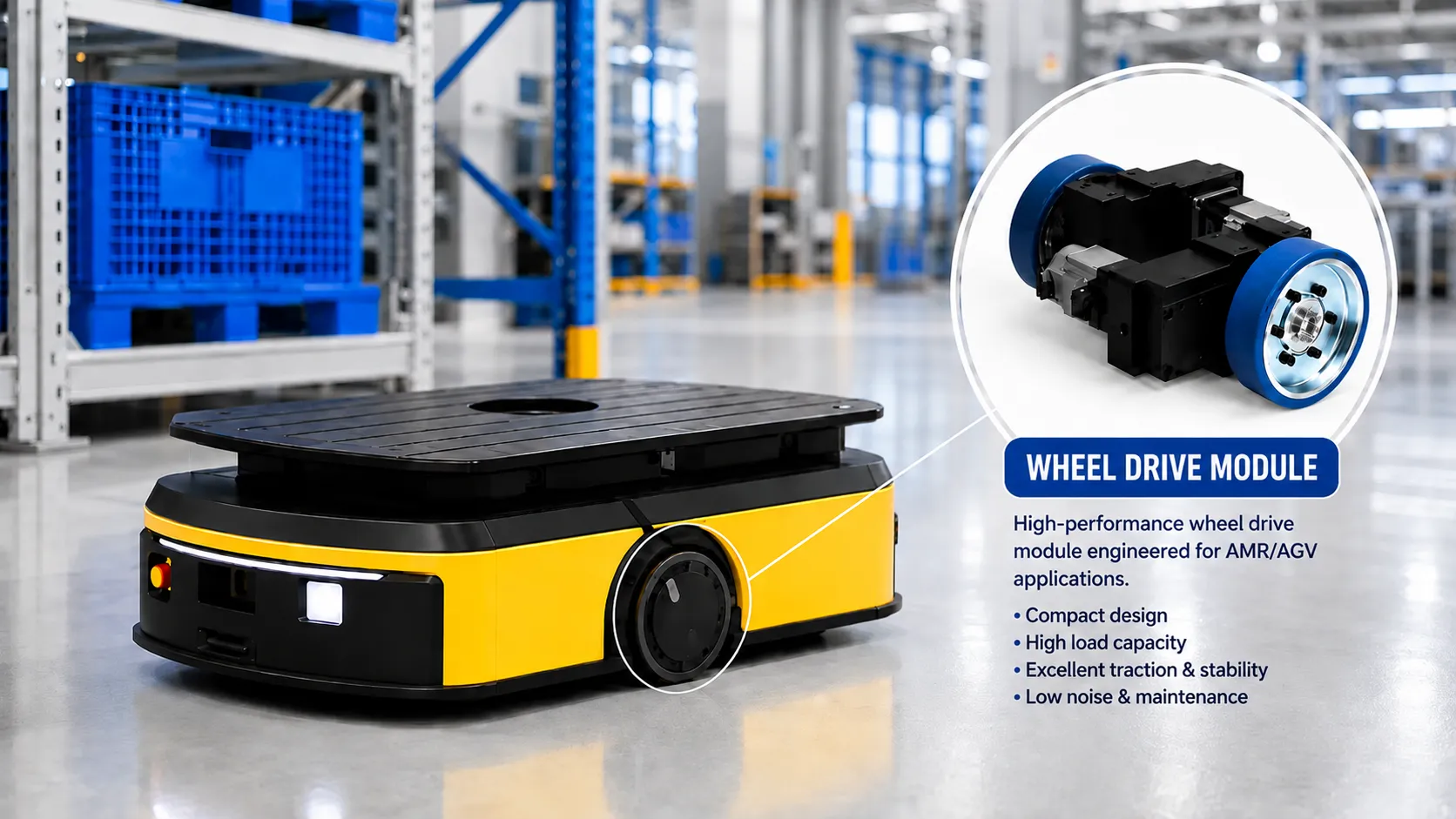
What is AGV Wheel? Quick summary of key selection points
AGV WheelIt is a chassis wheel set for automatic guided vehicles, AMR autonomous mobile robots and smart material handling equipment. It can be divided into driving wheel, driven wheel, shock absorber wheel and balance wheel according to function; different wheel materials, wheel diameters, hardness, bearings, eccentricity and configuration methods will affect the vehicle body load, steering, tracking accuracy, energy consumption and maintenance cycle.
- ● Wheel material: AGV/AMR commonly use high resilience PU to reduce rolling resistance, slippage and risk of deformation under long-term pressure.
- ● Structure: The drive wheel is responsible for power and positioning control, the driven wheel is responsible for support and steering, and the shock absorber wheel and balance wheel can improve the ground drop and ground contact.
- ● Configuration: Common AMR/AGV mostly use dual drive wheels with multiple sets of driven wheels, and adjust the number and position of wheels according to load capacity, route, speed and ground conditions.
- ● Selection information: The vehicle body weight, maximum load capacity, speed, daily operating hours, ground material, ramp conditions and installation dimensions need to be provided during the assessment.
When AMR/AGV starts, brakes, turns, climbs and passes through expansion joints, the load borne by the wheel group is not just the static weight distribution. Therefore, it is not recommended to only use "total weight ÷ number of wheels" to judge Specification. Dynamic load, center of gravity offset, ground height difference and continuous operation time should also be taken into account.
AGV Wheel Selection Checklist
| Selection items | Information that needs to be confirmed | main impact |
|---|---|---|
| Vehicle body weight | Empty weight, maximum load capacity, center of gravity position, jacking or traction mechanism | Wheel load, safety factor and Wheel group configuration |
| ground conditions | Epoxy, cement, steel, expansion joints, ramps, thresholds or drops | Wheel material, wheel diameter, shock absorber and balance structural requirements |
| Operating frequency | Daily working hours, start and stop frequency, speed, acceleration, deceleration and turning radius | Wear resistance, heat dissipation, bearing life and rolling resistance |
| Navigation | SLAM, laser, QR Code, magnetic stripe, visual or hybrid navigation | Tracking stability, vibration control and positioning error risk |
| Installation restrictions | Wheel diameter, wheel width, installation height, hole position, shaft hole, keyway and existing drawings | Available Wheel group structure and customized Specification |
In-depth smart production line: Analysis of common applications and pain points of AGV autonomous vehicles
Automation handling equipment in highly complex factories and warehousing environments usually faces the challenge of long-term, high-frequency continuous operation. The following will break down the daily operation of unmanned guided vehicles in smart factories, as well as the possible risks caused by incorrect selection.
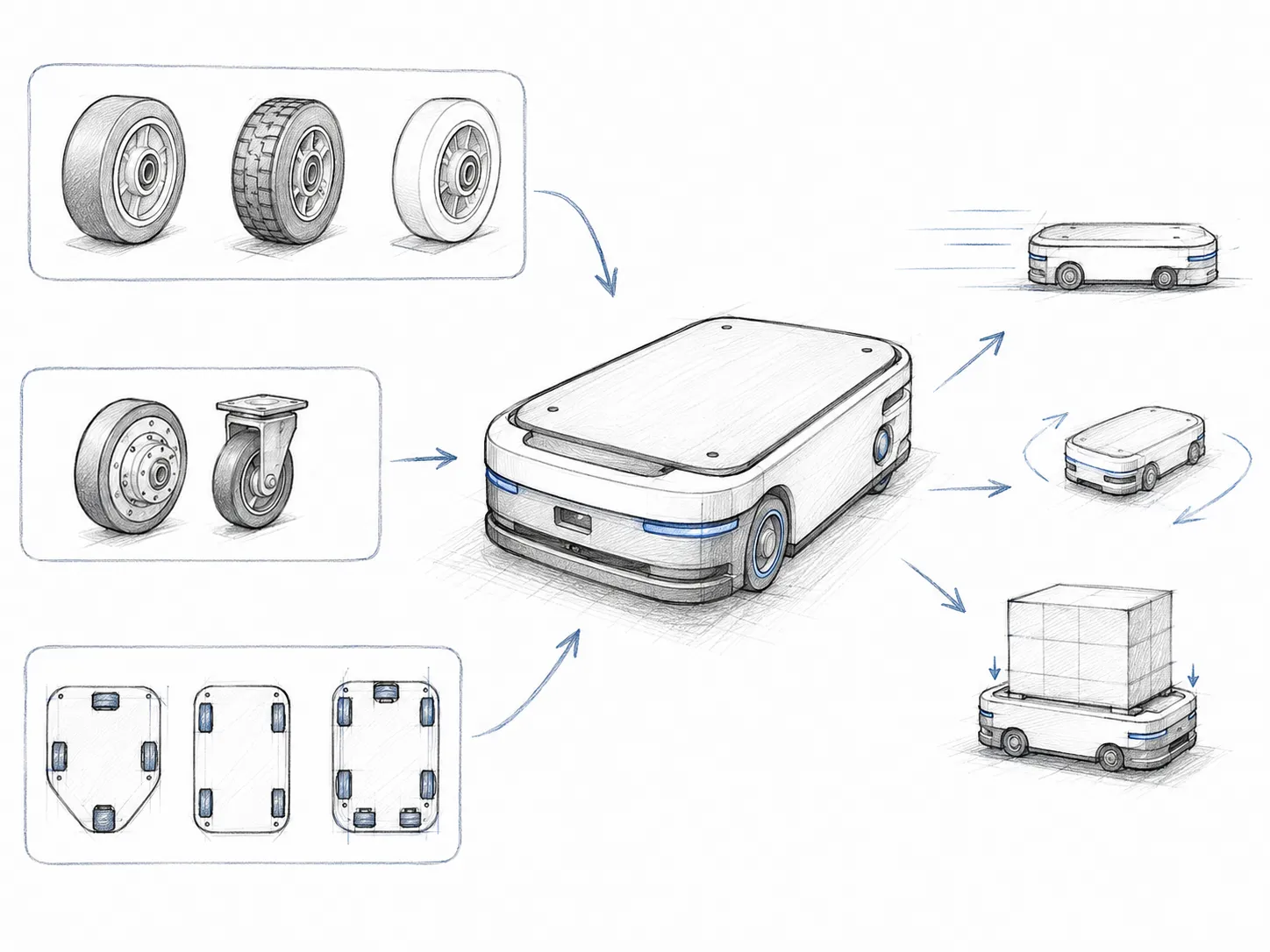
The material, structure and configuration of the AGV Wheel will directly affect the load-bearing stability, steering flexibility and walking efficiency of the AMR/AGV unmanned guided vehicle. Only by selecting the right Wheel group can the Equipment remain smooth and stable under different load capacities, road surfaces and operating conditions.
Analysis of the use cases of AGV autonomous vehicles in smart factories
In PCB factories, semiconductor factories, electronic assembly lines, precision processing plants and smart logistics centers, AGV unmanned handling Equipment is often used for long-distance cross-area automation material handling in warehousing areas, process sites and production lines. These usage scenarios often include complex terrains such as ground expansion joints, thresholds, ramps or height difference areas, and may also require entry into clean rooms or other special environments with ESD anti-static requirements. Therefore, smart track unmanned vehicles (RGV) and autonomous mobile robots (AMR) have also been widely used in recent years.
At the same time, in order to meet the automation scheduling requirements of smart manufacturing, AMR / AGV Equipment usually needs to operate continuously for 24 hours, and the Wheel group also needs to repeatedly withstand long-term dynamic loads, steering lateral forces and friction heat accumulation, so the wear resistance and structural durability of the Wheel material are extremely high.
Equipment risks and maintenance issues that may arise from choosing the wrong unmanned guided vehicle Wheel
When the material or configuration of the unmanned guided vehicle Wheel is selected incorrectly, it will often cause serious chain problems:
- ● Positioning deviation and increased energy consumption: When Equipment with a load capacity of hundreds of kilograms is stationary, if the Wheel material has insufficient resilience under high load capacity, it may cause permanent deformation, which will increase the instantaneous load and current consumption of the motor during startup, damaging the Equipment's endurance and navigation and positioning accuracy.
- ● Wheel surface damage and vibration transmission issues: If the heat dissipation capacity of the Wheel group is insufficient, long-term operation will cause the PolyurethaneWheel surface to be debonded, cracked or abnormally worn due to heat accumulation; if the Wheel material is too rigid and cannot absorb the impact of ground gaps, the vibration will be directly transmitted to the Caster, causing damage to the radar, sensors and electronic control components or data inaccuracy.
AMR/AGV Wheel group practical application video
The following video records the actual operating conditions of the Wheel 1165 Series AMR / AGV dedicated Caster in the Automation production line. From the video, it can be observed that the driven Wheel equipped with high resilience PU Wheel material and precision thrust bearings, when the Equipment starts and stops continuously, turns 90 degrees and passes through ground joints, the car body maintains stable grounding without obvious jitter or deflection, showing the relationship between the resilience of the Wheel material and low rotational resistance. Direct impact on AMR/AGV tracking accuracy.
- There is no obvious deviation of the vehicle body during continuous start-stop and 90-degree turns.
- The Wheel group maintains stable contact with the ground when passing through ground joints
- Verify the actual effect of high rebound PU Wheel material on tracking accuracy
If the video cannot be played normally, you can Go to YouTube to watch AMR / AGV-1 & -2 application videos.
Key points for purchasing the AGV Wheel set: How to balance low resistance, steering stability and tracking accuracy?
To select an Automation handling wheel set with excellent performance, you must not just look at "whether the dimensions are the same" or "whether the load is sufficient." You must also pay attention to the suitability of material science and mechanical structure to achieve the goals of low energy consumption, high tracking accuracy and long-term use.
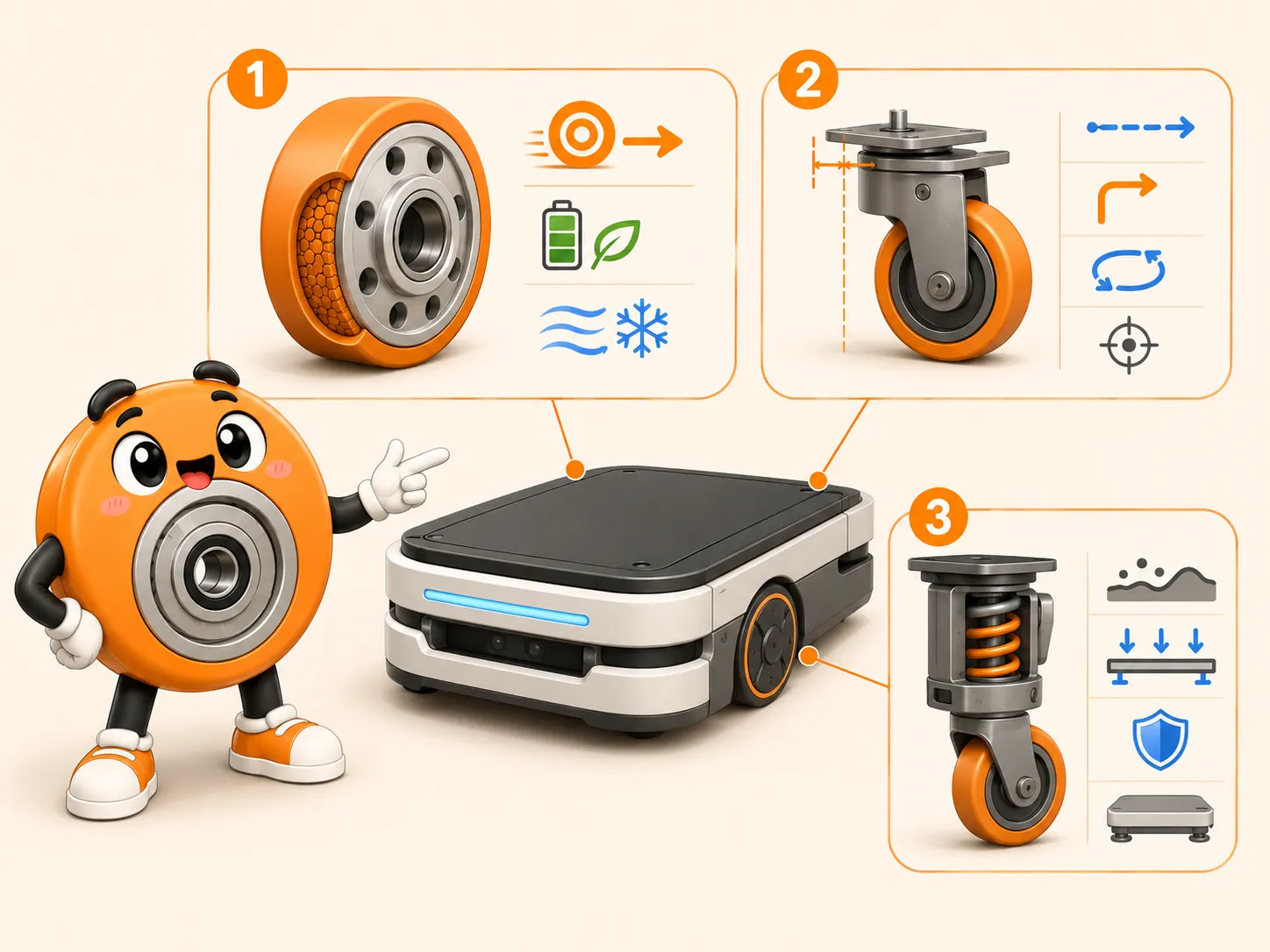
1. High resilience PolyurethaneWheel material, reducing starting resistance and energy consumption
In order to reduce the risk of permanent deformation of the wheel surface after long-term pressure, AGV wheel sets mostly use high-resilience Polyurethane (PU) material to take into account load-bearing capacity, wear resistance and low rolling resistance. High-resilience PU has extremely low hysteresis loss, which can effectively reduce energy loss caused by material deformation, reduce Equipment starting resistance and motor load, which is crucial to improving battery life efficiency. At the same time, if it is designed with an aluminum alloy Wheel core, In addition to achieving a lightweight structure, the high thermal conductivity properties of metal can also be used to improve the heat dissipation efficiency of the Wheel set and reduce the risk of heat accumulation and debonding on the Wheel surface caused by long-term operation.
2. Precise eccentricity design improves steering flexibility
The eccentricity (Offset) structural design of the movable Caster will directly affect the control performance of the AMR / AGV unmanned guided vehicle in narrow passages, 90-degree turns and in-situ rotation. If the eccentricity is too large, although the wheel is easy to rotate, it may snake, shift or shake when traveling straight, affecting radar positioning; if the eccentricity is too small, the steering resistance will be amplified, increasing the load on the drive motor. Therefore, high-performance unmanned guided vehicles mostly adopt a precisely calculated short eccentric structure design and match it with a high-precision flat thrust bearing to achieve both linear tracking stability under high load and smooth low-resistance steering performance.
3. Spring shock-absorbing structure improves the stability of the Wheel assembly on the ground
Modern Automation Equipment is usually equipped with expensive lenses, LiDAR radars, optical sensors and precision control modules. If the running ground is uneven and the shock absorbers are insufficient, the impact force may cause the components to fall off or become misaligned. The introduction of the Caster system equipped with spring shock absorbers can effectively absorb the impact and vibration of uneven roads, and maintain stable grounding of the wheel group through the suspension and balance structure, ensuring that the four wheels are always close to the ground and reducing wheel tire suspension. The probability of driving Wheel idling and positioning errors.
AGV/AMR Common Wheel Material Specification Reference Numbers
The following summarizes the key specifications of the three most common wheel materials used in AGV/AMR Equipment to provide a preliminary reference for selection. The actual values vary depending on the wheel diameter, formula, process and dynamic test conditions. It is recommended to refer to the Specification book and test report provided by the manufacturer.
| Wheel material | Common wheel diameter range | Shore hardness (Shore A) | Rebound rate reference value | Wheel load reference | Main advantages/limitations |
|---|---|---|---|---|---|
| High rebound PU (QPU / Polyurethane) |
75–200 mm | 80–95 A | ≥ 55% | 100–600 kg | Low rolling resistance, low hysteresis loss, resistant to eccentric wear; Formula compatibility needs to be confirmed in high temperature or oily environments. |
| High hardness and wear-resistant PU (VulkoTough) |
100–250 mm | 95–98 A | 40–55% | 200–1000 kg | Extremely high wear resistance, heavy load and long life; The resistance is slightly higher than high rebound PU, Suitable for heavy load low speed Equipment. |
| ESD anti-static PU | 75–150 mm | 80–92 A | 50–60% | 80–400 kg | Surface resistance 10⁶–10⁹ Ω, Suitable for semiconductor factories, clean rooms and electronic assembly lines. |
※ The rebound rate data is a common range in the industry, and varies depending on the formula and test conditions (temperature, dynamic frequency). The ESD surface resistance value needs to be confirmed according to the production line specifications (such as ANSI/ESD S4.1).
Application case: Electronics manufacturing factory AMR positioning offset when passing through expansion joints
Working conditions: The AMR in the electronics manufacturing plant needs to be transported back and forth between the storage area and the process site. The walking route includes epoxy floors, ground expansion joints, turning areas and short-distance high-frequency start and stop situations; when the equipment is running for a long time, the wheel group needs to repeatedly withstand load capacity, lateral force and ground impact.
Observed phenomena: When the car body passes through expansion joints and turning areas, it is prone to short-term jitters, and the frequency of tracking deviation and positioning correction increases. During the on-site inspection, the wheel surface wear, left and right wheel diameter differences, driven wheel rotation resistance, bearing status, shock absorber stroke and ground drop were simultaneously compared and compared. It was confirmed that the problem was related to the high hardness of the wheel material, insufficient shock absorber compensation and grounding stability.
Adjust direction: Re-evaluate the wheel diameter, wheel width, wheel material resilience, driven wheel rotation structure and shock absorber configuration, and adjust the wheel group according to the vehicle body weight, maximum load capacity, turning radius and installation height restrictions. After adjustment, the vehicle body's ground contact and stability when passing through expansion joints are improved, which can reduce sensor vibration, drive Wheel idling and positioning deviation risks.
*This case is de-identified, retaining the working conditions for project evaluation, inspection items and adjustment directions, and does not disclose the customer name, production line location and project confidentiality.
Analysis of AMR/AGV Wheel group configuration: How to configure drive and driven components for the unmanned guided vehicle Wheel?
Smart handling Equipment usually plans different Wheel group structures based on the handling load, travel route and site conditions. A correct Wheel group configuration can effectively improve the Equipment's steering control and tracking stability, and extend the Equipment's service life.
Comparison of common wheel group types of AMR/AGV
| Wheel group type | Main functions | Key points in selection |
|---|---|---|
| DriveWheel | Provide power output, control start, stop, steering and positioning | Grip, low rolling resistance, concentricity, wear resistance and wheel core stiffness |
| DrivenWheel | Supports the weight of the vehicle body and assists in steering and tracking | Rotary resistance, bearing accuracy, dust protection capability and lateral load resistance |
| Shock absorberWheel | Absorbs the impact caused by floor joints, thresholds and height differences | Spring travel, load-bearing capacity, impact absorption and ground stability |
| BalanceWheel | Distribute load capacity and maintain chassis level with multiple wheel grounds | Multi-axis linkage, ground compensation, heavy load stability and wheel surface eccentric wear control |
Basic configuration of driving wheel and driven wheel
Common AMR / AGV self-guided vehicles usually adopt a dual-drive Wheel (active Wheel) configuration with 4 or more sets of driven Wheels (auxiliary Wheels) to form a stable load-bearing and tracking structure. The driving Wheel serves as the core of power and can control the equipment forward, backward, braking and steering positioning; although the driven Wheel does not actively provide power, it still needs to withstand steering friction for a long time under 24-hour high-cycle continuous operation. Side load and dynamic impact, therefore there are also very high requirements for bearing accuracy, dust protection capability and rolling efficiency.
Balanced wheel group design under heavy load and height difference conditions
If the unmanned guided vehicle needs to operate under severe working conditions with high load capacity or large ground height differences, the wheel load may cause excessive local stress, accelerating wheel surface eccentric wear and structural fatigue. In practical applications, double-row Wheel, multi-axis balanced Wheel or crankshaft balanced Caster designs are often used to disperse ground pressure and improve Equipment stability. Through the mechanical balance linkage structure, the chassis can also be given better elastic compensation and ground-adhering capabilities. Reduce the problems of idling, slipping and positioning deviation of the drive wheel caused by the suspended wheel.
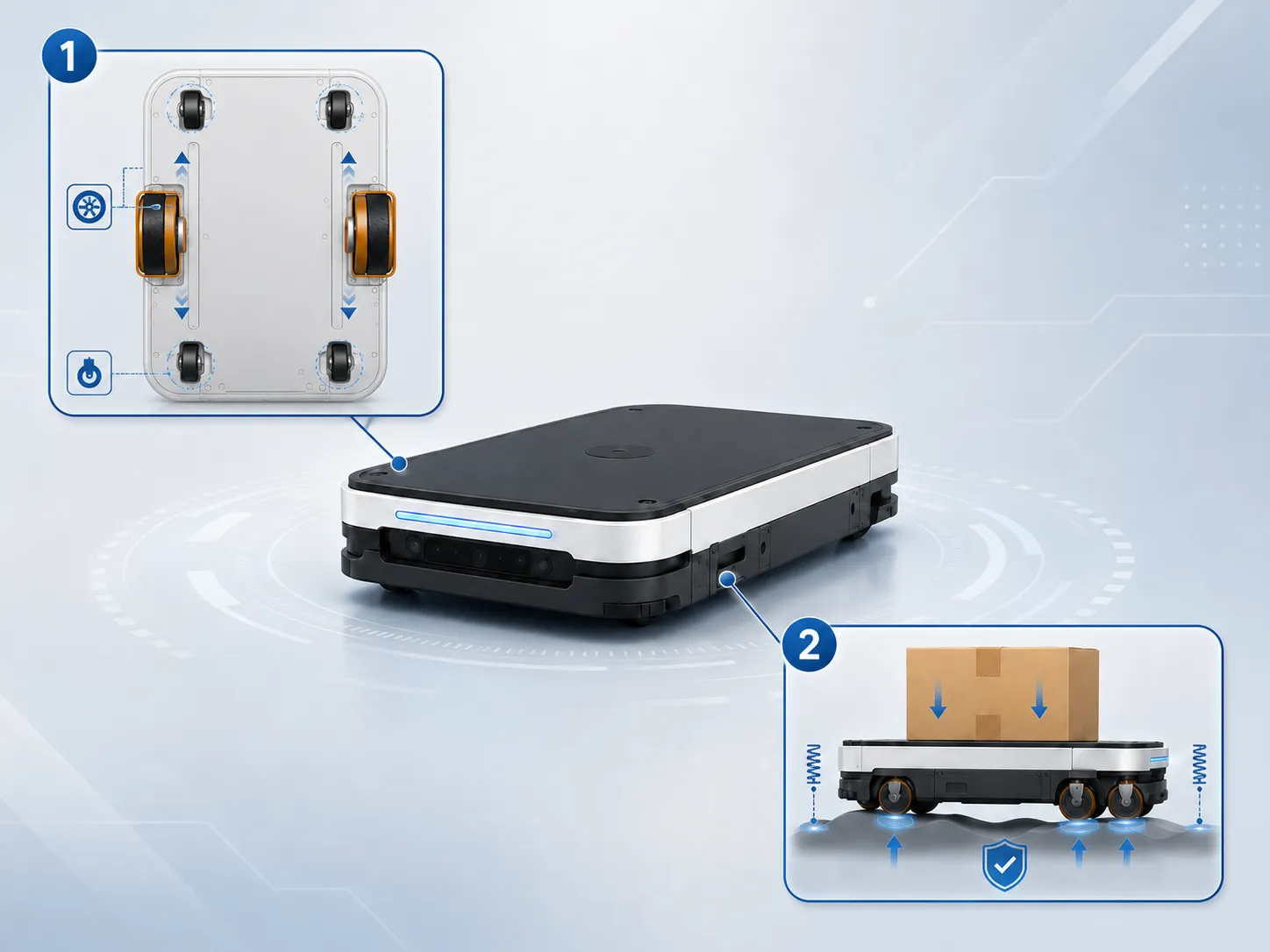
AMR/AGV autonomous vehicles will plan the configuration of the driving wheel and driven wheel based on the load, route and site conditions. A common design will use dual-driven wheels as the power core, with multiple sets of driven wheels to disperse the load-bearing pressure, improve steering control, tracking stability and long-term operation reliability.
Why choose "Deyushanghao Wheel"? AMR/AGV dedicated Wheel and smart logistics customization experience
Today, with the booming demand for smart logistics, Automation Equipment and high-cycle handling, Dexianghao Wheel can assist in evaluating the driving wheel, driven wheel, shock absorber wheel and balanced wheel configuration based on the AMR/AGV's body weight, maximum load capacity, operating speed, ground conditions, navigation method and installation interface, and provide corresponding wheel material, wheel diameter, bearing and bracket structure suggestions.
Nearly half a century of IndustrialWheel group manufacturing experience and ISO quality management
Since its establishment in 1977, Dekanshanghao Wheel has been committed to the R&D and manufacturing of Industrial Caster, Logistics Equipment Wheel and special Wheel groups. It has accumulated rich practical experience in industrial handling and has passed the strict ISO 9001 quality management system verification. Its factory products are also tested through dynamic load capacity, wear resistance, impact resistance and rolling resistance to ensure the safety during continuous operation.
1165 AMR / AGV dedicated CasterSeries: dedicated for high cycle operation requirements
In response to the needs of smart logistics, automated warehousing and high-cycle continuous operations, Dexianghao Wheel launched "1165 AMR / AGV Caster Full Series", and can be paired with "1163 Crankshaft Balance Caster"and"1163-1 Left and right balance Wheel” configuration, effectively improves the load-bearing stability of the chassis, greatly improves the ability of the Wheel to stick to the ground, and reduces the problems of idling and positioning deviation of the driven Wheel.
The secret to low rolling resistance: Polyurethane (PU) material and high wear-resistant Wheel configuration
Dexianghao Wheel has Polyurethane PU Wheel material processing and customization capabilities, and can provide different wheel material options such as "QPU (Qualthane) high resilience Polyurethane" and "VulkoTough high hardness and wear-resistant Polyurethane" according to different industrial environments, helping AMR / AGV Equipment reduce energy consumption, improve handling efficiency and extend the service life of the wheel set.
1163-1 Left and right balance Wheel application video
The following video shows the actual operating effect of the left and right balance wheel of Deyi 1163-1 on a multi-wheel chassis. Through the mechanical left and right linkage structure, the balance wheel can automatically compensate for the height difference on the ground, so that each wheel of the chassis can still be grounded synchronously under heavy load. It can be clearly observed from the video that even if one side of the wheel group passes through the ground drop, the opposite side of the wheel group remains close to the ground, effectively preventing the driving wheel from idling due to hanging in the air. And significantly reduce the positioning error of the vehicle body caused by the offset of the center of gravity. This design is especially suitable for AMR / AGV application scenarios that need to cross thresholds, expansion joints or ramps.
- When the ground level differs, the left and right Wheel groups automatically compensate and ground simultaneously.
- The drive wheel does not hang in the air or idle under heavy load conditions.
- There is no obvious shaking of the vehicle body when passing through door sills and expansion joints.
If the video cannot be played normally, you can Go to YouTube to watch 1163-1 Left and Right Balance Wheel Application Video.
Deyi Shanghao Wheel|AGV Wheel Group to Improve the Operation Stability of Smart Logistics Equipment
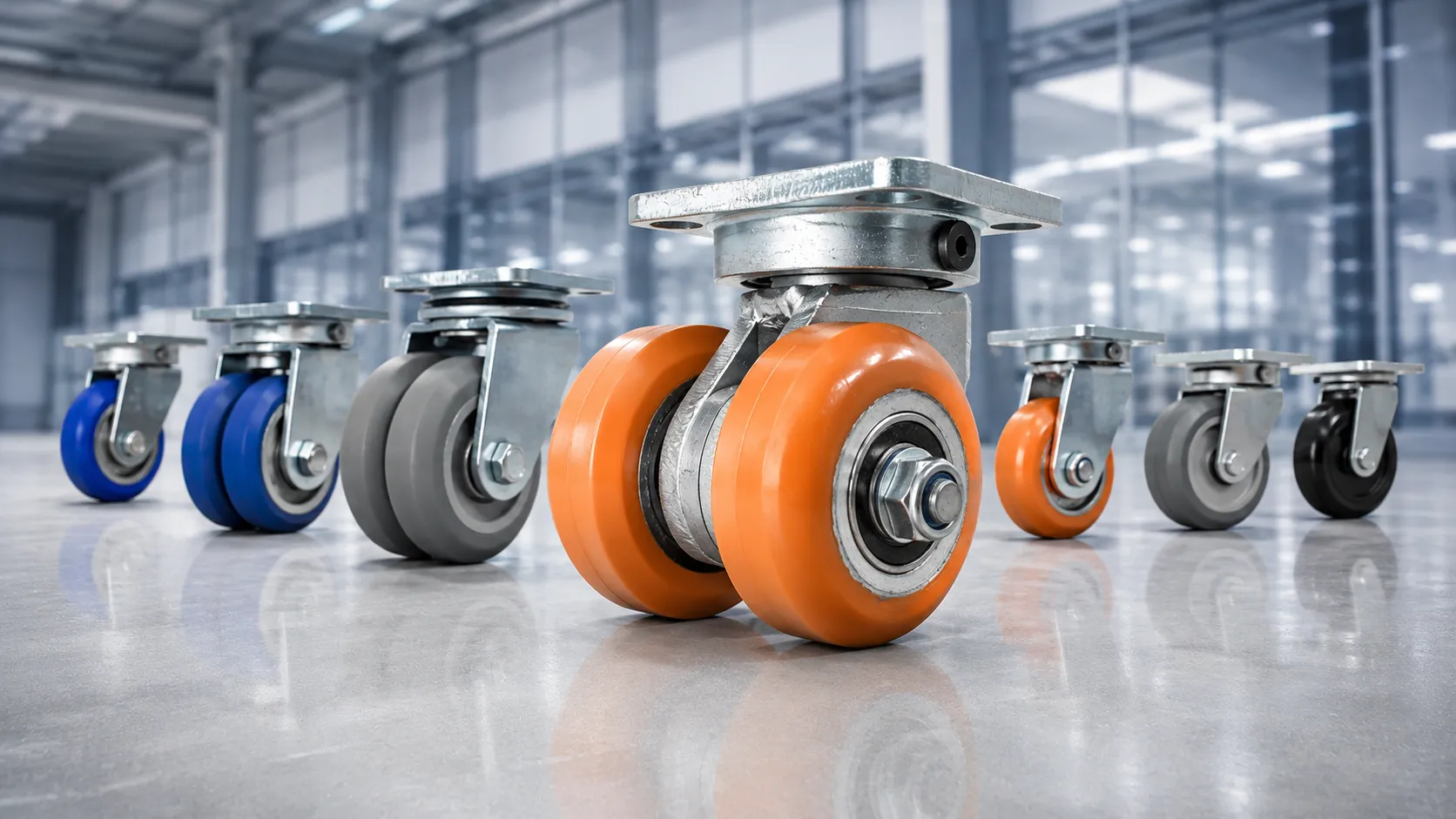
As a professional manufacturer of AGV wheel sets, Dexianghao Wheel can assist enterprises in planning more suitable Industrial Wheel set solutions based on Equipment load capacity, walking route, ground conditions and operating frequency. From wheel material selection, wheel diameter configuration to caster structural design, it can take into account low rolling resistance, wear resistance and long-term operation stability, improving the overall efficiency of the AMR/AGV handling system.
When planning the chassis structure of smart transportation equipment, the selection logic of the AGV wheel set is not just based on the basic load capacity or appearance size, but the wheel material, wheel diameter and wheel set structure of the Suitable for must be selected based on the terrain conditions, walking route, steering method and operating frequency. Through professional selection planning that suits the on-site working conditions, it can not only significantly reduce rolling resistance and failure risks under high-frequency continuous operation, but also save high maintenance costs for enterprises. Achieve more stable operating efficiency of the Automation system.
As a major IndustrialWheel tool manufacturer with both R&D strength and practical manufacturing experience, Dexianghao Wheel can provide enterprises with IndustrialWheel groups with low rolling resistance, high wear resistance and high stability. Whether it is smart logistics, automation production lines and AMR / AGV handling system needs, we can plan for you an effective, low energy consumption and long-lasting chassis Wheel group configuration.
Need help evaluating the AGV Wheel Group Specification?
Please provide the Equipment weight, maximum load capacity, walking route, ground conditions, operating frequency, speed and installation interface information. The Wheel engineering technical team will provide a suitable professional IndustrialWheel group solution based on the Equipment and on-site environmental conditions.
Contact us at WheelFrequently Asked Questions
If the AMR/AGV Equipment deviates from the path or is unstable in positioning, will it be related to the Caster or the driven Wheel?
Yes. AMR/AGV's wheel slips, uneven wear, excessive rotational resistance or unstable grounding may cause path deviation, steering jam and positioning errors.
It's very possible. We can think of an unmanned guided vehicle as a vehicle with the ability to think independently. If the Wheel slips, wears unevenly, or rotates unevenly, it will cause the weight of the vehicle to be uneven, causing walking deviation, skew, jitter, turning lag, or positioning errors.
Since modern laser, vision, magnetic stripe, QR Code or SLAM navigation all rely on a stable vehicle body, once the wheel group condition affects the movement of the vehicle body, it will cause an error between the actual position of the vehicle body and the system's judgment, which will trigger path deviation or unstable positioning.
Please refer to the following table for common car body instability phenomena and possible causes:
| Phenomenon | Possible reasons related to Wheel group |
|---|---|
| Turning to one side when walking in a straight line | The left and right drive wheels have different wear, different wheel diameters, and inconsistent grip. |
| Unsmooth, jittery or stuck when turning | The driven wheel does not rotate smoothly, the caster resistance is too large, and the bearing is abnormal. |
| It will jump when passing through gaps or small drops in the ground. | The wheel is too hard, the shock absorption is insufficient, the wheel diameter is too small or the ground is uneven |
| It starts to become unstable after loading capacity. | The center of gravity is shifted, the wheel load is insufficient, and the car body is unevenly grounded. |
| Offset in specific areas | There is oil stain, dust, slope, expansion joints, ditch cover or drop on the ground |
| Unsmooth start or stop at low speed | The friction coefficient of the wheel surface is not Suitable for, the driving wheel has insufficient grip or the rolling resistance is too high |
Why does AMR/AGV Wheel use high rebound PU? What is the difference between it and the ordinary PU Wheel?
High rebound PU Wheel pays more attention to elastic recovery, low rolling resistance, stable grip and tracking than ordinary PU Wheel, and is more suitable for AMR/AGV to run automatically for a long time.
The key lies in the difference in "rolling characteristics". Ordinary PU Wheels used for general trolleys only emphasize pure wear resistance and load capacity, and allow for large errors in accuracy. But Automation trucks need a Wheel that can stabilize positioning, is not easy to deform and slip, and has extremely low resistance; high rebound PU has excellent elastic recovery force and can quickly recover its shape after being compressed during load capacity walking, helping the vehicle body to maintain stable grounding when starting, stopping, turning and running for a long time.
If you casually replace it with an ordinary Industrial PU Wheel, the sensor may vibrate too much due to the excessive hardness of the Wheel surface, or the resistance may soar due to insufficient rebound of the material, resulting in slippage and eccentric wear, which may affect the equipment's chassis travel control judgment.
The difference between high rebound PU and general PU Wheel is shown in the table below:
| Compare items | High rebound PU Wheel | General PU Wheel |
|---|---|---|
| Main purpose | AMR, AGV, Automation truck, smart Logistics Equipment | General Industrial trolleys, EquipmentWheel, trolleys |
| Design focus | Stable grounding, low vibration, low resistance, stable grip and positioning | Wear-resistant, heavy-duty, floor-protecting |
| Resilience | Higher, faster recovery after stress | Depends on the recipe, usually not necessarily designed for AutomationEquipment |
| Grip | Pay more attention to starting, braking and traction stability during cornering | Depends on material hardness and ground conditions |
| rolling resistance | Compared with Suitable for long-term automatic walking, it can reduce energy consumption and starting resistance. | Depending on the hardness, wheel diameter and formula, there is a big difference. |
| Vibration and noise | More Suitable for low noise, low vibration fields | There may be significant differences due to wheel material or ground conditions. |
| Dimensional accuracy | Usually the requirements are higher, such as concentricity, wheel diameter stability and coating quality. | Generally, the tolerance for industrial applications is relatively wide. |
| Applicable situations | Electronics factory, Logistics center, automatic warehousing, semiconductor factory, smart factory | General warehousing, factories, equipment handling |
What are the driving wheel, driven wheel, suspension wheel and balance wheel responsible for? What should you pay attention to when selecting?
The driving wheel is responsible for power, the driven wheel is responsible for support and steering, the shock absorbing wheel absorbs impacts, and the balancing wheel helps disperse the load capacity and maintain the level of the car body.
The Wheel groups on the AMR/AGV vehicles are each responsible for different tasks:
- ● Driver Wheel: Responsible for power output and acceleration and deceleration control.
- ● Driven Wheel: Responsible for supporting and reducing drag resistance.
- ●Shock-absorbing Wheel: Responsible for absorbing seam impact.
- ● Balance Wheel: Used to maintain the vehicle body level and center of gravity balance.
When selecting, it is recommended to provide the following information to the manufacturer, which can greatly speed up the accuracy of Specification confirmation and customized evaluation:
- Vehicle body and load capacity information: including empty vehicle weight, maximum load capacity weight, vehicle body size, center of gravity position, estimated wheel load, and whether there is a jacking or traction mechanism, etc.
- Operating conditions: including the highest and commonly used walking speed, daily continuous operation time, start and stop frequency, acceleration and deceleration, turning radius, and whether it needs to rotate in place or climb.
- Ground and environmental conditions: including ground material (such as epoxy, cement, steel plate, etc.), flatness, whether there are expansion joints or thresholds, whether there is oil stains, water vapor or dust, and whether anti-static (ESD) requirements for electronics factory clean rooms are required.
- Installation interface information: including required Wheel diameter, Wheel width, installation height limit, shaft hole size, keyway, screw hole Specification, or existing 2D/3D part drawings and samples, etc.
How often does the AGV Wheel need to be inspected or replaced? What are the abnormal signals?
There is no fixed general replacement cycle for AGV Wheel, which should be judged based on daily operation time, load capacity, speed, ground conditions and wheel surface status.
If the AMR/AGV operates continuously for 24 hours or at high frequency, it is recommended to include the wheel group inspection as a routine maintenance item, and regularly check for wheel surface wear, flat spots, cracks, degumming, bearing noise, irregular rotation and left and right wheel diameter differences.
When the Equipment experiences walking deviation, stuck turns, abnormal vibrations, uneven start and stop at low speeds, increased power consumption, or increased frequency of positioning corrections, it usually means that the wheel material, bearings, driven wheel rotation or grounding stability need further inspection. It is not recommended to adjust the navigation parameters only.
When AMR/AGV passes through expansion joints, ramps or thresholds, how should the Wheel group be selected?
Priority should be given to evaluating the more appropriate wheel diameter, wheel material resilience, shock absorber stroke and balanced wheel configuration to reduce the risk of impact, suspension and slippage.
When the route includes expansion joints, ramps, thresholds, ditch covers or height differences, the Wheel group must not only bear load, but also maintain stable grounding. If the Wheel diameter is too small or the Wheel material is too hard, the vehicle body will easily transmit ground impacts to the sensors and control modules, resulting in positioning errors or abnormal shutdowns.
In practice, high rebound PU, shock absorber driven Wheel, crankshaft balance Caster or multi-axis balance wheel group can be evaluated based on the ground drop, vehicle body load capacity, speed and turning radius, so that the chassis can still maintain ground contact and tracking stability on uneven roads.
When choosing an AGV Wheel, what specifications need to be provided to the manufacturer?
At least the vehicle body weight, maximum load capacity, speed, operating time, ground conditions, route height and installation dimensions should be provided.
The complete data can be divided into four categories: the first is the car body and load capacity data, including empty weight, maximum load capacity, center of gravity position, number of wheel groups and estimated wheel load; the second is operating conditions, including speed, daily operating time, start and stop frequency, turning radius, and whether it rotates in place or climbs.
The third is the ground and environmental conditions, such as epoxy floors, cement floors, steel plates, expansion joints, ramps, thresholds, oil stains, dust, water vapor or ESD anti-static requirements; the fourth is the installation interface, such as Wheel diameter, Wheel width, installation height, shaft hole, keyway, screw hole position and 2D/3D drawings. The more complete the information, the Wheel material, Wheel diameter, The structure of the bearing and wheel group is closer to the actual working conditions.